
Development takes time, trust, and the right connections. Years of listening to our network has helped us anticipate our partners' needs, catalyse impact, and support development efforts. The results of our eighth Annual Partners' Survey confirm that and push us further.
Beyond shaping how we deliver on the needs of the network, the partners' survey captures stories that help us map our collective impact, learn what works, and see how impact can be scaled or replicated. We want to understand not just what was achieved, but for whom: the end users of better data systems, the populations included through more comprehensive data collection, and the communities served through improved decision-making.
How data changes lives
Throughout this survey, partners shared glimpses of life-changing impact: in Argentina's Lujan de Cuyo, an inclusive-by-design water chatbot now serves 140,000+ residents with real-time consumption alerts to build resilience to water stress; in Uganda, a Data Values Advocate established the country's first Disability Data Forum, opening pathways for integrating disability data into national planning; and in Malawi, a CAN-supported data science fellowship enabled the optimization of life-saving blood supply delivery routes in flood-prone districts.
These stories matter. They show us how better data improves lives.
Building on lessons from our network
Before we even saw the results of the 2025 Annual Partners' Survey, insights gathered through our daily interactions and collaborations were helping shape our approach for the year ahead, especially as we prepare to gather the data for development community at the Global Data Festival and Kenya Space Expo & Conference in Nairobi in June.
As we sorted through the survey responses from partners across government, civil society, academia, multilateral, donor, and private sector institutions in all regions, their experiences, priorities, and aspirations helped bring into focus where our efforts are working, and where we can do more to help our network create impact and change lives.
These are the six approaches that are supporting our network.
1: Capacity building enables change
Through CAN initiatives, the team was able to acquire skills in EDA, Analysis, Geospatial data, Data storytelling among others. Additionally, GPSDD allocated resources for my organizations to undertake Organization Development and Systems Strengthening
— NGO/CSO partner, 2025 Annual Partners’ Survey.
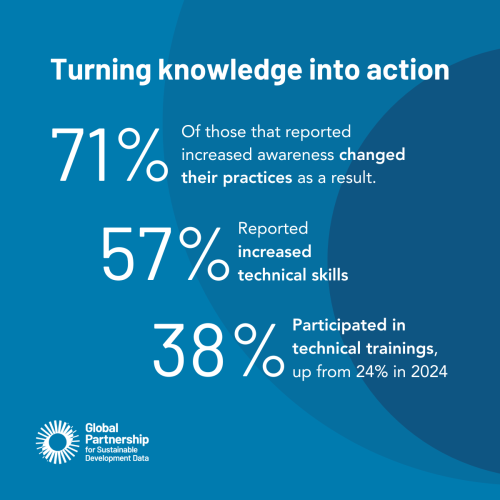
When it comes to what our partners want to get out of their engagement in the network, capacity building topped the list. In our role as a learning convener, we understand the power of connecting across the network to provide opportunities for skill development and transformational learning. Through this approach, our partners aren't simply learning through our work — they are transforming knowledge into action.
That shift from learning to doing showed up across sectors: from building local capacities in using open-source technologies for improved data collection and evidence-led policymaking in the Dominican Republic, to data science trainings to over 500 data-driven individuals across Africa, to facilitating 17 data science fellowships in social innovation organizations through the Capacity Accelerator Network, alongside multiple national statistical systems strengthening collaborations and initiatives we coordinated.
2: South-South and peer learning over expert instruction
Beyond just solving problems, our partnership with the Global Partnership for Sustainable Development Data has opened exciting doors for collaboration. We have had the privilege of holding working sessions with our counterparts in Colombia and Ghana, which has greatly strengthened our relationships and knowledge exchange with other nations in the Global South.
— Government partner, 2025 Annual Partners’ Survey.
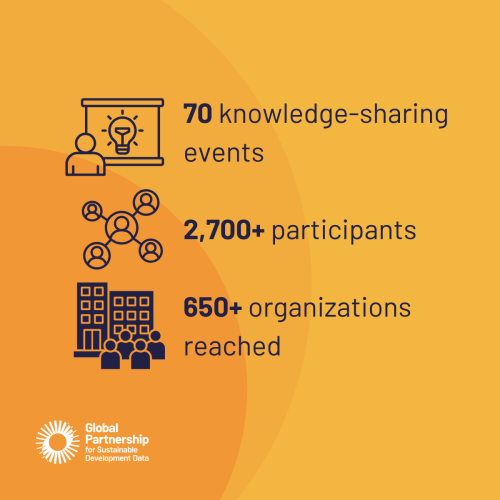
Partners learn more effectively from each other's real-world experiences, and the numbers back this up. 68% of partners surveyed confirmed this is their preferred engagement format, followed by 57% who are eager for connections to implementing partners working on similar challenges. The bottom line: partners value horizontal learning networks over vertical knowledge transfer. This is why we facilitate direct, targeted knowledge sharing between governments and data practitioners working through similar challenges.
A standout example is the Make Inclusive Data the Norm (MIDN) Initiative, a pioneering South-South collaboration between Colombia, Ghana, and Kenya. MIDN enabled the three countries to learn from each other's experiences in advancing inclusive data and creating policies that reflect and improve people's lives. Following the successful first phase, the initiative entered its second phase earlier this year with an extension through December 2027, expanding to include Nigeria and Senegal.
3: Ethical foundations before AI hype
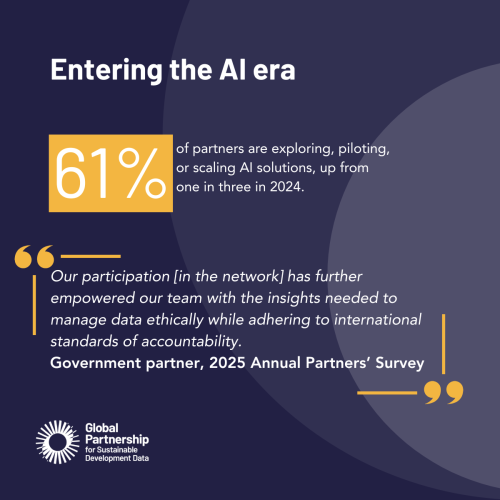
The proportion of partners exploring, piloting, or scaling AI solutions jumped from 35% in 2023 to 61% in 2025. For those partners not yet implementing AI, the top challenges were limited institutional capacity, resource constraints, and ethical concerns. This reflects what we’ve been hearing over the past few years — the path to AI requires stronger ethical grounding and core capacity building, and those foundations are urgently needed.
Through our engagements in national and international governance discussions, we are bringing the needs and expertise of the network to the table. Over the past year, we brought together think tanks and civil society to coordinate unified messages to shape the future of global data and AI governance. A landmark moment in this work: when the Global Digital Compact created a UN data governance working group, our CEO was selected as Vice Chair representing non-state stakeholders, enabling direct engagement in shaping the global AI governance agenda. At the national level, we supported Kenya’s responsible AI adoption, following the production of the 2023 AI Practitioners’ Guide translating global principles into local guidance to support the launch of Kenya’s National Artificial Intelligence Strategy 2025-2030. Meanwhile, our own strategy, Shaping Data and AI for Fair, Sustainable Progress, further reinforces our commitment to accountable, inclusive AI.
The network's priorities confirm this integrated approach: when asked about their interests for the upcoming Global Data Festival, 62% expressed interest in AI and emerging technologies, while 60% prioritised inclusive data practices — reinforcing that partners see innovation and foundational principles not as competing priorities, but as advancing together. This maturity reflects years of collective learning: the path forward isn't choosing between innovation and inclusion; it's ensuring each strengthens the other.
4: Centring on inclusion
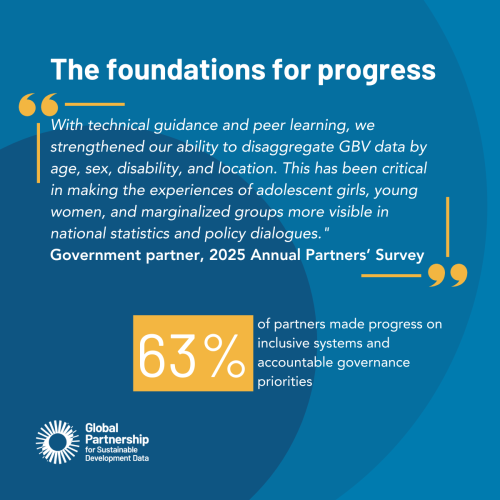
We are committed to positioning inclusive data principles as foundational infrastructure for emerging technologies. The survey responses validate this approach: nearly two-thirds of partners made progress on inclusive data systems and accountable governance priorities through their engagement with us.
Across the network, we worked with partners in 2025 to put these principles into practice, developing new resources and supporting progress on inclusive data systems. The Data Values Starter Pack, developed through year-long consultations across 200+ organizations in 63 countries, provides actionable steps for implementing Data Values. The Inclusive Data Playbook and Make Inclusive Data the Norm Compendium consolidated years of learning into replicable methodologies designed by and for Global South actors. Two new champions— the Government of Malawi and the I-Count Coalition —joined the Inclusive Data Charter, while six IDC champions (Nigeria, Sierra Leone, Cameroon, Paraguay, Cape Verde, and the IMPACT Initiative) advanced implementation: from Paraguay presenting national guidelines for disability data harmonization, to Ghana establishing a digital, citizen-led approach to female genital mutilation data collection.
5. The ingredients for success
The Global Partnership is a multiplier and amplifier - the expertise of core staff provide huge value add, but the reach of networks enables delivery and impact takes this to the next level
— Donor/Foundation partner, 2025 Annual Partners’ Survey
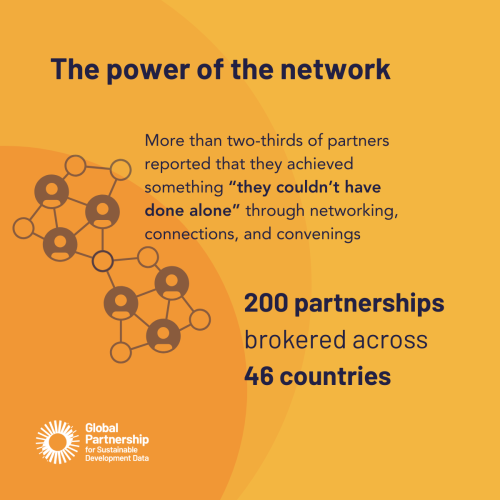
Partners don't come to us to run their projects. They come to us for the ingredients, recipes, and connections that help them build solutions suited to their context. "Knowledge of data initiatives" and "UN connections" rank among the top three motivations for engagement. The role partners value most is our strategic ability to convene, connect, and act as a catalyst. And it works: through engaging with the network, 67% achieved something they "couldn't have done alone."
6. Long-term engagement over quick wins
The Data Festival held in Punta del Este (2023) was an amazing opportunity for the data community to come together around the use of data for development across many fields. Fast forward to today and we are facing a very different landscape. The rapid emergence of AI, evolving data needs, and a shifting context for international cooperation are putting many of our partners under pressure. These are conversations we need to have in Nairobi. Over the years we have made a strong case for data for development. In this new moment, I hope our conversations will help shape a future that is more open, responsible, and sustainable.
— Humanitarian Open Streetmap Team
The intensive support we provide in brokering specific data partnerships, and the peer exchanges we offer, are leading to sustained change. But to expand those benefits to the network as a whole, we need to expand our engagement and learning opportunities.
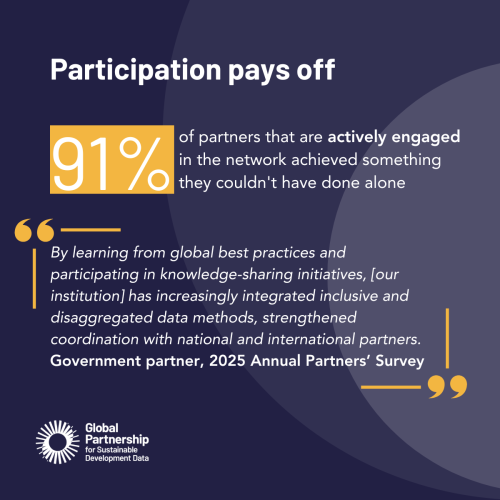
Sustained collaboration is where transformation happens. The Copenhagen Framework journey exemplifies this. Years of ongoing engagement, peer exchange, and advocacy work led to citizen-generated data being formally endorsed by the 56th Session of the UN Statistical Commission in 2025. Similarly, our earlier engagement with Uruguay to develop a legal framework for accessing privately-held data, is now influencing data governance practices across Latin America and the Caribbean. And Paraguay's Water Information System scaled from pilot to targeting water and sanitation projects in underserved communities using real-time data. These are all examples of multi-year partnerships that evolved from initial engagement to sustained collaboration and systemic transformation.
Building the opportunities our partners want at the Global Data Festival
The 2025 Partners' Survey results are helping us create an event that will deliver on what is truly important to our network. The 2026 Global Data Festival and Kenya Space Expo & Conference will bring together a diverse ecosystem of actors — including governments, civil society, multilateral institutions, donors, and the private sector — with a focus on practical skills, peer exchange, and grounded innovation. 67% of partners say they are likely or possibly planning to attend. For many partners, particularly those in Sub-Saharan Africa and Latin America and the Caribbean, this festival creates opportunities for engagement and collaboration that would otherwise be difficult to access.
Hands-on technical labs emerged as the most requested session type (66%), while conventional panel discussions ranked lowest. The parity between partner interest in AI and emerging technologies and inclusive data practices confirms that the network sees these not as separate priorities, but as converging ones. Partners aren't choosing between innovation and equity — they need both. So we're building the festival accordingly: sessions focused on developing practical skills around AI and emerging technologies; peer learning connecting national statistical offices, civil society organisations, regional partners, and technical experts for exchanges on experiences and solutions; and inclusive data practices as a through-line, not a side track.
The Global Data Festival and Kenya Space Expo & Conference in Nairobi this June represents a key opportunity for us to deliver on the priorities of the network and create a moment of collective action: strengthening partnerships, sharing practical knowledge, and advancing more inclusive and effective data systems across the globe. Join us! Registration is now open.
Tell us your story
Whether you're an NSO strengthening statistical systems, a civil society organisation advancing inclusive data practices, a regional partner seeking connections to the UN system, or a technical expert ready to share practical knowledge, there's a space for you and your story in this network.
Share your story and help the entire network know what works: contact [email protected] or [email protected].