
Luján de Cuyo, a bustling municipality in Argentina's Mendoza province, is home to more than 172,000 residents across 15 districts. Nestled in a semi-arid region with only 200 mm of annual rainfall, the city depends heavily on seasonal meltwater from the Andes. However, a changing climate is threatening this equilibrium.
A city at the crossroads: When scarcity meets opportunity
Forecasts from the General Department of Irrigation warn of a 50 per cent reduction in available meltwater by 2050. Together with ageing infrastructure, inefficiencies, and population growth, the urgency of this crisis is clear.
In recent years, Aguas Luján, the city’s public water utility, found it was losing nearly 40 per cent of the city’s water supply to leaks, largely due to aging infrastructure and outdated distribution systems. At the same time, water consumption had more than doubled over the past decade, driven by population growth, urban expansion, and rising demand. This created an unsustainable strain on already scarce resources, especially in a region that relies almost entirely on meltwater from the Andes.
To the municipal leaders of Luján de Cuyo, the water crisis revealed not just a technical failure but a deep governance challenge. The answer, Luján realized, lay in the hands of its residents. The municipality committed to using disaggregated, inclusive, and community-based data to guide its response. As a signatory to the Inclusive Data Charter (IDC), its approach was not only to address the environmental and infrastructural stress on water systems, but also to prioritize equity, confronting systemic inequalities, gender disparities, invisible disabilities, and the exclusion of vulnerable neighborhoods from service access and decision-making.
A digital ally: Luji Aguas
Consequently, in 2024, the Municipality of Luján de Cuyo launched Luji, a citizen-facing chatbot that redefined the relationship between residents and their water utility. More than just a chatbot, Luji was an essential part of a broader project to increase access and bring services to more than 140,000 people.
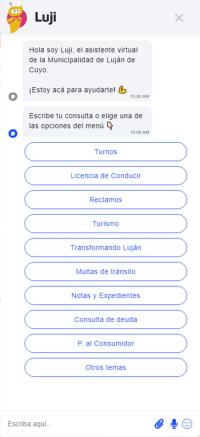
With Luji, residents gained real-time access to their water data, empowering them to make informed, timely decisions. Features included:
- Usage alerts and notifications to monitor consumption.
- Billing updates to avoid payment delays
- Notifications of high consumption levels that could indicate leaks
- Goal setting functions and access to educational resources to support households in using water more sustainably.
With Luji, we not only measure consumption, but encourage citizens to understand and take ownership of their behavior.
- Municipal official, Luján de Cuyo
Results that speak for themselves
In a pilot zone, the impact was immediate, helping to cut unaccounted-for water to 25.85 per cent, significantly lower than the provincial average of 40 to 45 per cent.
The ANC [unaccounted-for water] in our pilot is now lower than Mendoza's estimates. But we still have to fix the invisible leaks and fine-tune the measurements.
- Ing. Nicolás Bonanno, Project Engineer
The integration of real-time metering and automated alerts resulted in:
- Quicker leak repairs thanks to earlier detection.
- Sharp decrease in manual errors.
- Fairer billing to reduce costs to low-consuming, often low-income, households
Inclusion by design: Getting to the last mile
Unlike many digital tools that overlook vulnerable users by assuming digital literacy, reliable access, or a one-size-fits-all design, Luji was built with inclusion at its core. Most systems focus on efficiency, but Luji, grounded in Luján de Cuyo’s IDC Action plan, delivers real-time alerts, accessible language, and tailored support. It ensures all residents, including those in low-income, underserved, or communities of persons with disabilities, can track, manage, and act on their water use. It’s equity, made digital.
Luji was developed in collaboration with residents to understand real needs and design solutions accordingly. Community input shaped everything from the technology interface design to functionality. Upcoming improvements include voice interfaces for blind and visually impaired users, and the provision of multilingual content, further steps towards leaving no one behind.
Municipal digital literacy workshops brought this spirit of inclusion to the streets. The chatbot is playing a vital role in the city's efforts to promote access to information and bridge the digital divide.
Measurement is not a cold or technical tool: it is a powerful lever for transforming realities. Because when we measure well, we make better decisions. And when we make better decisions, we bring the State closer to those who need it most. Measuring means guaranteeing rights. Measuring means moving toward a more equitable and just society.
- Municipal Leadership Statement
From households to policy makers: Learning from data
What makes Luji unique is its integration into the strategic Power BI monitoring platform, enabling policy makers to make informed and timely, evidence-based decisions that benefit the community and protect resources.
Beyond its policy impact, Luji is driving cultural change. Personalized tips, community challenges, and campaigns like “I Care for Water” are changing behaviors and perceptions around water use. In a region long accustomed to abundance, this cultural transformation may be the most enduring change.
Key dashboards available to the public include:
- Historical consumption data
- Self-diagnosis of water habits
- Notification preferences
- Strategic planning dashboard
Challenges along the way
Naturally, innovation came with obstacles. These included outdated manual operations and coordination gaps. But the city was committed to success, and the project team was empowered to implement a centralized data platform, digitize meters to streamline consumption monitoring, and foster cross-cutting collaborations.
When we plan with evidence and act in a coordinated manner, we don't just manage well: we build strong, present, and trustworthy local governments. Because data isn't numbers: it's people, it's stories, it's decisions that improve lives.
- Municipal Planning Unit
Looking ahead: Luji's future
The next phase of the chatbot rollout includes ambitious but practical goals:
- Integrate voice and multilingual interfaces
- Use predictive analytics to plan water demand and investments
A scalable model for the Global South
What Luján de Cuyo has shown is that real change does not always require large infrastructure budgets. Through data innovation, collaboration, and inclusive design, Luji offers a replicable model for others across the Global South, especially those facing similar climate and resource constraints.
To all cities that dream of transforming reality: we invite you to join us on this journey! In Luján de Cuyo, we know that well-used data is a powerful tool for building equity. But there is no equity without inclusion, and there is no inclusion without listening. Listening to people is the first step to changing everything.
- Municipality of Luján de Cuyo
Luján's experience is both a success story and an open invitation.
- To local governments: Start now, wherever you are, with whatever you have at hand! Don't wait for the perfect moment, make it perfect with your people. Because when you work with commitment, creativity, and community, there is no obstacle that stops change.
- To funders and donors: Focus where it matters. Invest in real projects that bring digital into the daily lives of our neighbors. And not only that, Let's commit to developing the capacity of our local teams to sustain these advances over time. Transformation begins with confidence.
- To technologists: Think of everyone from the first click. Design with empathy, with neighborhoods, with diversity, with the voices that aren't always heard. Technology that doesn't include, doesn't transform.
- To policy networks: It's time to look inward. Support, amplify, and value solutions that emerge from the territory. Luji, and many other subnational cities, are living proof that resilience and good governance have a local face and global power.
Mercedes Bustamante is the Data Project Lead, GIS Manager, and Open Government Representative at the Municipality of Luján de Cuyo.
Yesica Betti is the Project Lead for Open Government, Open Data, International Certifications, and Legal Advisor to the Municipality of Luján de Cuyo.
