Environmental changes are increasingly affecting countries and their economies. At a 2023 Festival de Datos side event, National Statistical Offices (NSOs) from across Latin America and the Caribbean gathered to discuss urgent development challenges and the opportunities and innovations data could bring.
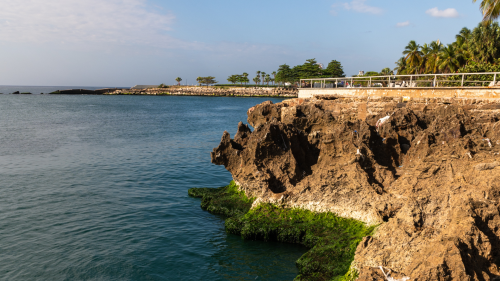
One challenge that stood out was the increasing prevalence of sargassum–a type of algae that floats on the ocean’s surface–whose large blooms are now disrupting marine life, aquaculture, and tourism, and posing risks to public health. With climate change raising water temperatures and shifting currents, what once drifted lazily out at sea now frequently smothers the beaches.
A new partnership emerges
The discussions at the Festival de Datos sparked an idea that evolved quickly into an innovative partnership between the Global Partnership and Humanitarian OpenStreetMap Team (HOT) —not just to monitor sargassum, but to reimagine how communities and technology can work together to close data gaps and improve environmental monitoring. As a team, we launched a plan to build local capacities to leverage open-source technologies for better data, better policymaking, and development progress.
Drones, data, and decision making in Dominican Republic
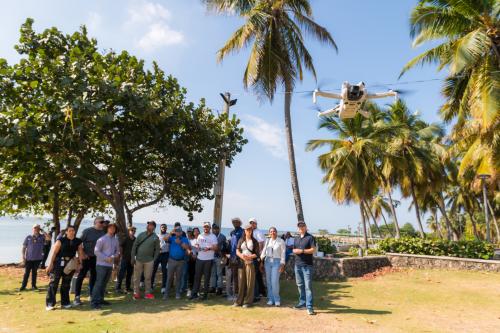
Recently, we facilitated the first workshop, in collaboration with the National Statistical Office of the Dominican Republic (ONE), on the use of drones for monitoring sargassum and other local environmental changes. In addition to building technical skills for drone-based cartography, the training focused on how to apply new open-source technologies and integrate citizen-generated data and participatory mapping into statistical processes to help close critical data gaps. You can read more at HOT’s blog.
Over three days, experts from across the country learned how community-generated data can help track sargassum and inform policy. From flying drones along the coastline to analyzing community mapping data, to experimenting with tools like HOT’s Drone Tasking Manager, the workshop introduced open-source technologies that can democratize environmental monitoring and support locally driven solutions. It also sparked new thinking and renewed hope for a data-driven approach to managing sargassum and other evolving environmental challenges in the region.
Five steps to successful data collaborations
The success of this initiative offers valuable lessons for other countries and regions facing similar data challenges. Here are five key ingredients.
Prioritize partnership building
Partnership brokering plays a crucial role in identifying needs and potential partners that can offer support and ensure success in new collaborations. When ONE recognized the need to address data gaps in sargassum monitoring, they turned to the Global Partnership and and other entities to explore who could support this process. This early investment in scoping and partnership development was key, driving political commitment and momentum for policy impact.
Work together for a sustainable solution
Overcoming long-standing challenges of siloed data and disconnected systems will require enthusiastic participation from the community. Engaging relevant stakeholders early, including civil society, local governments, and private sector actors, will help align efforts, maximize participation, and ensure lasting relevance. In the Dominican Republic, it was crucial to engage local organizations, businesses such as hotel chains, and local and national governments to support the ongoing monitoring efforts.
Build local capacities
Investing in people delivers the best long-term value. Training on flexible, open-source technologies sparked interest in further learning and opened the door for broader applications across sectors. Sharing new skills and technology catalyzes innovation and unlocks new opportunities.
Create networks for collaboration
Beyond workshops, ongoing peer learning is vital. The initiative established a network for participants to share updates and strategies for managing sargassum in real time. This facilitates cross-regional exchanges on what’s working and new ideas.
Invest in impact
Even with open-access technology and innovative data sources that can fill data gaps relatively cheaply, funding is needed to scale efforts and support local leadership. Investing in human capital and open-source technologies can supercharge data efforts, offering a high-impact model for addressing data challenges and boosting evidence-based decision-making.
Where it starts, and where it goes next
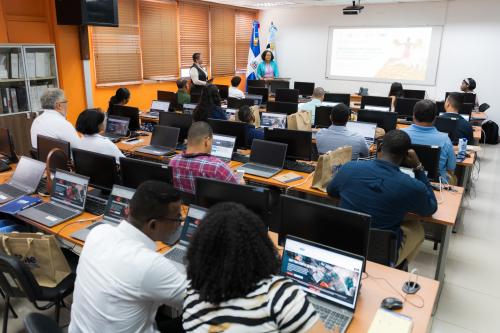
This initiative shows how open technologies, local skills, and community engagement can come together to create timely, scalable solutions.
Following the successful delivery of the pilot program in the Dominican Republic, the Global Partnership and HOT are committed to continuing and expanding this work in terms of data generation. Sargassum is one of many environmental threats communities across the Caribbean are facing. But scaling efforts will require continued investment and support. This is an opportunity for funders and donors to support local data projects that deliver impact and innovation.
What began with algae can become a model for collective action.