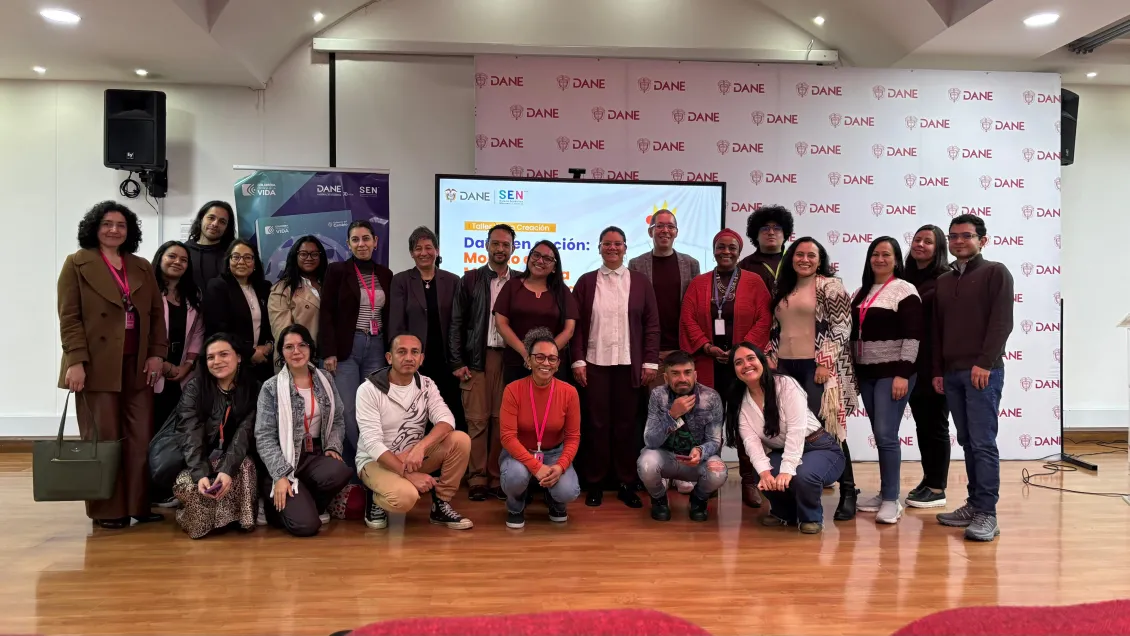
 Participants at the national workshop for advancing citizen data, hosted by DANE, Colombia, in June 2025. Part of the MIDN initiative.
Colombia has a strong track record of exploring and implementing new data sources, and working to make data more inclusive and representative.
Through the Make Inclusive Data the Norm initiative, the country focused on strengthening and institutionalizing the use of data collected by citizens along with traditional data sources to get a clearer picture of people’s lives, particularly underrepresented communities, and inform better policy and practice. This included the development of a new Citizen Data Framework and an innovative Maturity Model, which lets organizations see how ready they are to integrate citizen data. Colombia's work also involved co-creating new digital tools and collaborating with communities on sensitive and under-reported issues.
The approach
Datos en Acción Project and Citizen Data Framework
Datos en Acción (Data in Action) represents Colombia’s flagship project within MIDN. Spearheaded by DANE, Colombia's NSO, the project aimed to build the country's Citizen Data Framework through collaborative co-creation.
Objectives:
- Construct a national framework for integrating citizen data into the National Statistical System.
- Strengthen local capacities and promote the ethical, responsible use of citizen data.
- Advance the implementation of the Copenhagen Framework on Citizen Data, aligned with the Colombian context.
- Establish regulatory, technical, and methodological guidelines.
Project components:
Civil society organization (CSO) inventory: 153 CSOs were identified, of which 96 are actively generating citizen data across 12 thematic areas, including: gender equality and diversity, climate action and environmental management, territorial governance and local planning, ethnic, disability and rural differential approaches, among others.
Co-creation workshop series: DANE conducted 11 in-person and two virtual workshops across multiple locations (Bogota, Medellín, Cali, Cartagena) to consult on shaping how the project would achieve its objectives. Workshops averaged 60 participants from CSOs, academia, NSS organizations, and international experts. Themes covered included: data quality criteria for citizen data, citizen participation in statistical processes, territorial opportunities and challenges, as well as the co-creation and validation of the data Maturity Model and development of a web application for collecting citizen data.
Outcomes and results
The Citizen Data Framework
The participatory process outlined above resulted in Colombia's Citizen Data Framework, which establishes regulatory, technical, and methodological guidelines for ensuring the quality, inclusion, and utility of citizen data within the National Statistical System. The framework includes guiding principles for ethical citizen data collection, technical recommendations for data quality and integration, and the Maturity Model (see below) that recognizes diverse organizational capacities. The first version was released in September 2025, with validation through an international Expert Meeting Group of the Collaborative on Citizen Data in Bogotá in October 2025. The final version is scheduled for release in the second quarter of 2026, after which DANE will develop implementation tools including guides, checklists, and training materials throughout 2026.
Citizen Data Maturity Model
Within the Datos en Acción project, MIDN supported the development of an innovative Citizen Data Maturity Model, co-created directly with citizens and civil society organizations. During June and July 2025 co-creation workshops, participants proposed nine different maturity models reflecting diverse organizational contexts and capacities. DANE's Citizen Data core group then consolidated these proposals into a unified model that was validated through additional workshops in September 2025.
The Maturity Model features four progressive levels across multiple dimensions including data collection, processing, analysis, protection, output production, communications strategy, and use and impact. Rather than imposing a single quality standard, the model recognizes the diversity of citizen data initiatives and provides pathways for continuous improvement regardless of starting point.
This approach balances the need for quality assurance with the imperative of inclusion, ensuring that community-based data initiatives are not excluded due to capacity constraints. Pilots with civil society organizations were conducted in November-December 2025 to refine the model based on real-world application, with the model now integrated into the National Statistical Plan as a tool for both self-assessment and institutional support.
App Diversa and web application development
MIDN supported the development and piloting of App Diversa, a multi-module web application co-created with citizens to capture statistical information on issues that are difficult to measure through traditional methods. The application represents an alternative strategy for generating more inclusive official statistics while promoting two-way interactions between DANE and citizens. Development involved three iterative pilot phases testing different platforms beginning with bubble.io in March 2023, moving to Drupal in April 2024, and culminating in Python in late 2024, with continuous validation through community workshops in Medellín, Cali, and Bogotá.
The first module focuses on discrimination measurement for people over 18 years old, with questions co-designed through extensive validation sessions with representatives from LGBTIQ+, Afro-Colombian, indigenous, and youth communities. The 2023 pilot achieved a 65 percent five-star user rating, demonstrating strong community acceptance. MIDN support from the Global Partnership provided crucial consulting on technical feasibility, usability evaluation, and development of a 360-degree communications strategy. The application launched in October-November 2025, with future modules planned for gender-based violence, access to public services, and water quality based on policy needs identified through community dialogue.
Training and capacity building
MIDN supported extensive capacity-building initiatives designed to strengthen both institutional and community capacity for citizen data. A virtual training course titled "Citizen Data: Fundamentals for Statistical Information Generation" launched in September 2025 through the National Statistical System's virtual training platform, enrolling over 200 participants in its first cohort. The course covers basic concepts, statistical production processes, and ethical considerations, making citizen data approaches accessible to CSOs, government entities, and the general public.
The Autonomous Workshops Program represents an innovative decentralized approach to capacity building. MIDN supported the development of a practical guide enabling CSOs to lead workshops on citizen data in their own communities. Between August and September 2025, seven organizations conducted autonomous workshops, reaching more than 2,000 people, demonstrating the potential for scaling knowledge beyond DANE-led sessions. The program promotes social appropriation of knowledge while building territorial capacity and empowering CSOs as trainers.
Challenges and solutions
Bridging the language gap: DANE’s learning journey in co-creating with civil society
The Datos en Acción project faced several significant challenges that required adaptive strategies. Building trust between DANE and civil society organizations required moving beyond email consultations to genuine co-creation, a shift that involved conducting 13 workshops over two years in multiple cities rather than relying on desk-based feedback mechanisms.
Bridging the language gap between technical statistical terminology and community vocabularies required DANE to develop accessible materials and invest time in mutual learning, ensuring that communities could meaningfully engage without requiring advanced statistical training.
Additional challenges included limited connectivity in some territories, varied digital literacy across populations, and the need to balance official quality standards with respect for diverse community methodologies. DANE addressed these through the development of the Maturity Model's progressive approach, creation of physical materials for low-connectivity areas, and extensive piloting and validation of digital tools like App Diversa before full deployment.
Read more about how Colombia is tackling inequality through an intersectional approach to data.