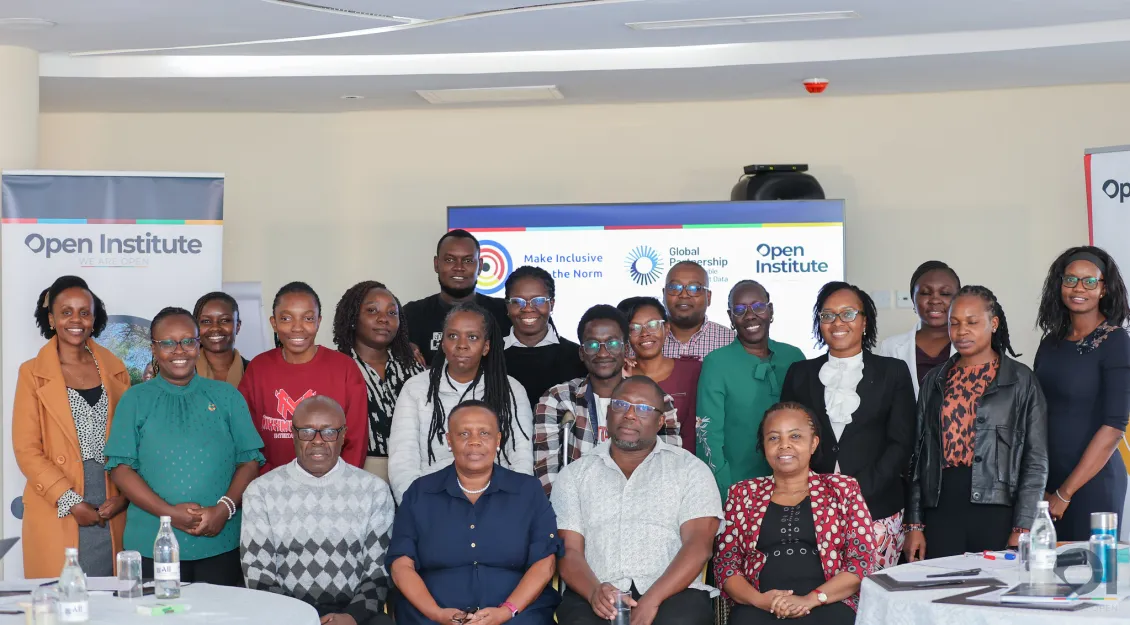
 Participants at the three-day inclusive data workshop in Nairobi, Kenya, in May 2025. Part of the MIDN initiative.
Kenya’s focus in Make Inclusive Data the Norm (MIDN) was on institutionalizing inclusive data so that it is a central part of the national data strategy and approach, not an add-on or afterthought. To achieve this, Kenya’s National Bureau of Statistics (KNBS) began executing joint training on inclusive data for government and civil society organizations (CSOs), and advocating for inclusivity in Kenya’s Strategy for Development of Statistics. KNBS also began the foundational work to support the Ministry of Gender in establishing a new gender statistics unit, to inform better policymaking.
The approach
Kenya’s progress centered around institutionalizing citizen data through KNBS and improving coordination across the National Statistical System. In the MIDN project period, KNBS and the SDG Kenya Forum signed a Memorandum of Understanding to formalize civil society organization (CSO) engagement and to further jointly champion citizen data in the country and beyond. Through joint workshops, including a three-day national workshop in Nairobi in May 2025, stakeholders from across sectors influenced a more inclusive Kenya Strategy for Development of Statistics (KSDS), while KNBS also undertook a review of its citizen data quality criteria within the Kenya Statistical Quality Assurance Framework (KeSQAF).
Outcomes and results
Balancing quality and inclusivity for SDG reporting
Strategic partnerships with the SDG Kenya Forum and Open Institute have led to the refining of quality standards for citizen data, making sure that information generated by citizens is both inclusive and reliable, while structured capacity building will help ensure that stakeholders have the skills needed to collect, analyze, and use citizen data across the National Statistical System.
Through the collaboration with the SDG Kenya Forum, KNBS revised its citizen data quality criteria and formally integrated them into its statistical frameworks through the KeSQAF. This was significant both in terms of ensuring data quality standards, but also from a political point of view; it represents a public commitment to valuing data from citizens as much as data from traditional sources.
Training and capacity building
Capacity-building initiatives are essential for addressing gaps in analytical skills, technology use, and effective data dissemination. As part of the MIDN South-South learning initiative, the Open Institute led the national scoping and training efforts. A number of persistent capacity gaps that hinder the use of inclusive data practices across the National Statistical System were identified in the scoping. These included limited knowledge and skills in collecting and applying citizen data; problems with data quality when it came to validation, integration, analytics, and visualization; and gaps in coordination and collaboration across institutions, as well as limited access to information due to poor data infrastructure and a shortage of institutional policies and arrangements to support inclusive data.
To address this, the capacity development led by the Open Institute included both in-person training workshops and the development of an e-learning platform, which will enable these key concepts to be shared at scale.
What was equally encouraging [along with Kenya’s other achievements through MIDN] was the shift in strategy to embed capacity building directly into systems. Through partnerships with the Open Institute, Kenya is rolling out online and in-person training that prioritizes inclusion not as a module, but as a mindset.”
— Karen Bett, Program & Policy Lead, Global Partnership for Sustainable Development Data
Collaborating for better disability data and governance
The United Disabled Persons of Kenya (UDPK) is an umbrella organization comprising various organizations of persons with disabilities (OPDs) across different disability categories in Kenya. Its mission is to promote full and meaningful participation of persons with disabilities in all aspects of life. Prior to Make Inclusive Data the Norm, the Global Partnership supported UDPK’s "Enhancing Disability Data in Kenya" project, which aimed to strengthen the capacities of persons with disabilities and their organizations in handling disability data, ensuring the enhancement of community-driven data. It also sought to establish innovative partnerships with data stakeholders to improve disability and community-driven data.
Through MIDN, as part of the training led by the Open Institute, UDPK mobilized its partners to benefit from the training, and organized a study trip where KNBS, members of the government, and other CSOs were able to have hands-on experience with the data that OPDs produce. Read more in this blog by the Open Institute.
Paving the way for stronger gender data and better policymaking
Through MIDN, Kenya began working towards establishing a gender data hub at the State Department of Gender, which serves as a key partner in advancing inclusive statistics and data practices.
A number of key steps were taken to begin the foundational work to guide the Ministry in establishing a gender statistics unit. This included:
- Conducting an audit of sources of gender data and policies in Kenya (official and non-official).
- Carrying out a benchmarking study on the Children Information System to guide the Ministry in developing a Gender Information System.
- Developing a roadmap to establishing the unit, including policy priorities, technical skills, infrastructure, and some guidance on funding.
Challenges and solutions
Balancing quality assurance with minimum thresholds
Despite initial challenges, such as disjointed operations between KNBS and CSOs, balancing quality assurance with minimum thresholds, and applying validation criteria to qualitative data, efforts are underway to align these criteria with the National Statistical Office's (NSO) code of practice and ensure an inclusive process.
Applying validation to qualitative data
Kenya continues to work on refining the criteria for validating qualitative data. There are plans to review and refine the criteria for validating qualitative data to ensure they align with the NSO's code of practice.
Coordinating across the National Statistical System
Moving forward, Kenya plans to hold Citizen-generated Data Technical Working Committee meetings, enhance data literacy, conduct a second citizen data inventory, and develop a comprehensive citizen data database. These efforts aim to improve coordination across the National Statistical System and strengthen the integration of inclusive data practices.
[Citizen data] is good when it adds value. We are not trying to make everything an official statistic...Datasets might not meet the criteria of KNBS, but how else can that data be used? Is it useful to the community? Can it be improved to ensure its use?"
— KNBS
It's critical to be able to showcase what [citizen data] models work in communities, whilst building capacity in the communities to be able to use the data themselves."
— SDG Kenya Forum
Read more about Kenya’s progress in making inclusive data the standard through the Make Inclusive Data the Norm initiative:
- Kenya accelerates progress on inclusive data through national workshop and community fieldwork - Global Partnership for Sustainable Development Data
- Building Inclusive Data Systems in Kenya: From Dialogue to Action - Open Institute