These cross-cutting resources form the foundation for understanding inclusive data as both a principle and systemwide practice. They clarify the values, such as equality, participation, and transparency, that underpin ethical and effective data systems and show how data actors can translate these values into structures, strategies, and plans.
These resources cover the why and how to get started before diving into specific technical areas, such as disaggregation. They cover topics such as the data value chain, human rights-based approaches, stewardship, and political will—all of which underpin inclusive data systems. Users may wish to start with this section to familiarize themselves with overarching concepts, then move on to later sections to explore thematic or technical applications of these principles.
The Data Value Chain: Moving from Production to Impact
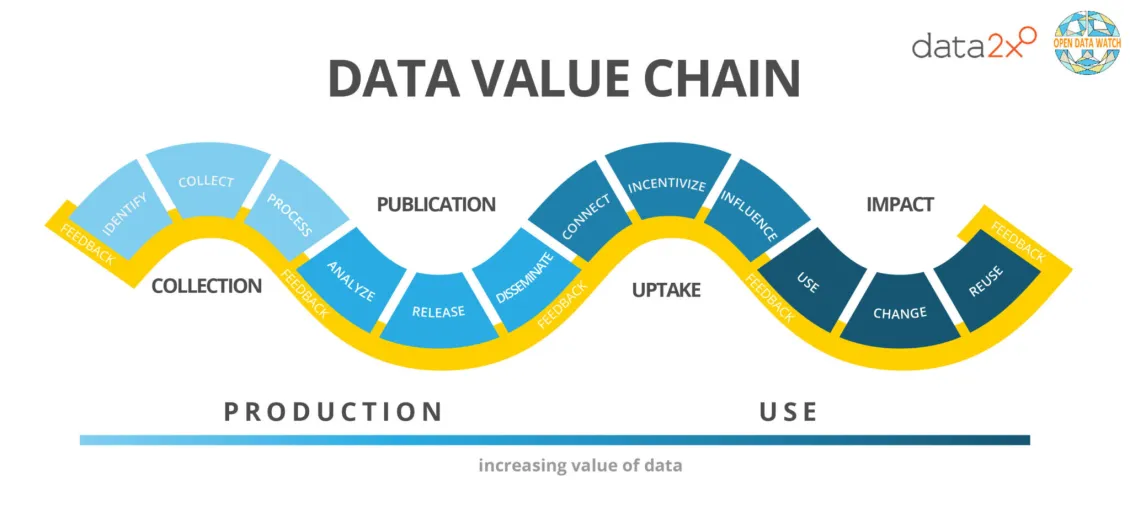
Author: Open Data Watch
Type: Conceptual framework
Location: Open Data Watch website
Overview: This one-page resource lays out a concise, high-level model of the data process in four broad stages: collection, publication, uptake, and impact. It breaks each of these stages into 12 steps, e.g., identify, analyze, disseminate, influence. It serves as a useful tool in managing and explaining data processes.
Key topics:
- Data value chain stages
Stages in the data value chain:
- Cross-cutting
Includes case studies or examples: No
Additional information: Framework used to structure the 12 steps of the data value chain in the descriptions of resources in this Inclusive Data Playbook.
Inclusive Data Charter Action Plans
Author: Global Partnership
Type: Online repository/examples/implementation resource
Location: Global Partnership website
Overview: This is a collection of national and organizational action plans to implement the Inclusive Data Charter produced by IDC Champions. It serves as a “library of examples” showing how different countries and organizations commit to and operationalize inclusive data principles in practice, representing diverse country and organizational contexts. Action plans lay out concrete steps, timelines, and responsible actors for translating the IDC into national or sectoral strategies.
Countries include Argentina, Colombia, Kenya, Nigeria, Paraguay, the Philippines, Senegal, Sierra Leone, the United Kingdom, and Zanzibar. There are also links to action plans for 13 civil society and multilateral organizations, such as UNICEF, the World Bank, and Save the Children.
Key topics:
- Implementation of inclusive data systems
- Strategic planning for data disaggregation, citizen data, and intersectionality
- Institutional roles, coordination, and governance
- Monitoring, evaluation, and follow-up
- Examples of priority actions, such as closing data gaps or improving capacity
Stages of the data value chain:
- Cross-cutting
Includes case studies or examples: Yes, every plan serves as an example.
Additional information: A good starting point for planning systemic approaches to improve inclusive data. New action plans may be added over time.
Inclusive Data Governance Structures—Suite of Tools
Author: United Kingdom’s Statistics Authority
Type: Example/internal structures/strategy process
Location: UK Statistics Authority webpage
Overview: These resources illustrate how national statistics systems organize inclusive data governance and embed inclusive data into strategy, oversight, and institutional structures. They provide insights on the processes and structures, including:
- An independent task force, Inclusive Data Taskforce, that developed a set of recommendations for how United Kingdom data systems could be more inclusive
- The “Inclusive Data Taskforce Report: Leaving No One Behind—How Can We Be More inclusive in Our Data?”, which presents the evidence, recommendations, and implementation plan
- A standing advisory committee, National Statistician’s Inclusive Data Advisory Committee, created after the Taskforce concluded to provide ongoing monitoring and advice on how to implement and sustain inclusive data reforms. It includes links to the terms of reference, minutes, papers, and other committee resources
Key topics:
- Institutional design and governance for inclusive data
- Strategy and recommendations for improving inclusive data
- Accountability, oversight, and review/monitoring
- Stakeholder consultation
- Implementation planning and follow-through
Stages of the data value chain:
- Cross-cutting
Includes case studies/examples: Yes, each of these resources serves as a model and contains further examples of actions to take, such as stakeholder consultations.
Additional information: These examples are more strategic than technical, relating to data governance.
5 Ps to Build and Sustain Political Will on Inclusive Data
Type: Advocacy framework
Location: Global Partnership website
Overview: This resource distills lessons from Inclusive Data Charter Champions into a concise framework of five levers: peer influence, participation, partnerships, persistence, and platforms. It aims to help data practitioners build and sustain political support for inclusive data systems. It also discusses common challenges, such as limited capacity, institutional siloes, and political cycles, and proposes approaches to mitigate them.
Key topics:
- Advocacy for inclusive data systems
- Political will and sustaining momentum in changing political contexts
- Institutional coordination and capacity
- Stakeholder engagement and participation
- Enabling environments and platforms for visibility
Stages of the data value chain:
- Cross-cutting
Includes case studies/examples: Yes, there are brief examples from IDC Champions who have used the 5 Ps in practice, including Benin, Cameroon, and Colombia.
Additional information: A high-level resource focused on enabling conditions, which may be useful in the planning stages for inclusive data.
Fundamental Principles of Official Statistics
Author: United Nations Statistics Division
Type: Foundational framework/principles
Location: UN Stats website
Overview: This framework consists of a set of principles adopted by the UN General Assembly to guide national statistics systems in producing high-quality, objective, and trustworthy statistics. It emphasizes professional independence, transparency, confidentiality, competence, and the obligation to serve all populations, which is integral to making data inclusive and credible.
Key topics:
- Impartiality and objectivity
- Professional ethics and statistical integrity
- Confidentiality and privacy
- Transparency and openness of methodology
- Commitment to comprehensive coverage
- Coordination across agencies
Stages of the data value chain: Cross-cutting
Includes case studies/examples: No.
Notes: Widely accepted across NSOs and global statistics systems. The IDC can be read alongside this framework to reinforce the legitimacy of inclusive data work.
A Human Rights-Based Approach to Data
Author: Office of the High Commissioner for Human Rights
Type: Normative framework/guidance
Location: OHCHR website
Overview: This resource links human rights standards and the SDG principle to Leave No One Behind to data practices, setting out the definitions, rationale, best practices, and guidance on participation, data disaggregation, self-identification, transparency, privacy, and accountability.
Key topics:
- Participation of relevant groups in data planning, collection, dissemination, and analysis
- Data disaggregation to allow for detailed analysis and to identify inequalities
- Self-identification, i.e., promoting populations that are self-defining, and individual choice to disclose
- Transparency to ensure clear, open, and accessible information about data operations
- Data protection, privacy, and confidentiality
Stages of the data value chain:
- Cross-cutting
Includes case studies/examples: Yes, some illustrative examples are mentioned, e.g., disaggregation efforts in Mexico.
Additional information: Complements the IDC, providing detailed normative safeguards. Particularly useful when planning disaggregation strategies and instruments, ensuring marginalized groups are not harmed.
Good Practices and Resources on Sustainable Development Goals Monitoring
Author: United Nations Statistics Division
Type: Online repository/good practices portal
Location: UN Stats website
Overview: This is a dynamic, crowdsourced repository of good practices, tools, country strategies, and resources on SDG monitoring, with a significant subsection on data disaggregation and inclusive data. It aggregates contributions from NSOs, UN agencies, regional commissions, and expert groups, rather than providing structured guidance. The data disaggregation and inclusive data section provides links to national disaggregation strategies, global tools, examples, and common challenges.
Key topics:
- National disaggregation strategies and action plans
- Tools and methods for data disaggregation
- Case studies and country examples
- Disaggregation challenges, e.g., capacity, data gaps, standards
- International expert group resources and frameworks, including, for example, the Inter-Agency and Expert Group on SDG Indicators’ series of tools on data disaggregation
Stages in the data value chain:
- Cross-cutting
Includes case studies/examples: Yes, many linked pages are country strategies or disaggregation plans.
Additional information: User-contributed resources vary in quality and relevance; organized by contributor groups, not topic.
Participatory and Inclusive Data Stewardship: A Landscape Review
Author: Ada Lovelace Institute
Type: Guidance/landscape review
Location: Ada Lovelace Institute website
Overview: This report surveys the evolving field of data stewardship through a participation and inclusion lens. It makes the case that data is never neutral and that data governance must reflect the rights and agency of data subjects. It explores different models, the tensions between existing mechanisms and participatory practices, and the challenges of ensuring meaningful inclusion in data systems. It is intended for policymakers, governance bodies, civil society, and technical actors designing data systems who wish to align stewardship with equality and participation goals—core foundations of inclusive data.
Key topics:
- Definitions and foundational concepts of data stewardship, participation, and inclusion
- Legal, contractual, and normative mechanisms of stewardship
- Governance models, e.g., data trusts, cooperatives, data commons, and intermediaries
- Power dynamics and structural challenges that affect participatory practices
- Enabling conditions, e.g., norms, institutional structures, capacity, regulatory environment
- Gaps, barriers, and future directions in participatory and inclusive stewardship practice
Stages in the data value chain:
- Identify
- Connect
- Incentivize
- Influence
- Use
- Change
- Reuse
Includes case studies/examples: Yes, there are examples of data trusts, cooperatives, and participatory governance, among others.
Additional information: A conceptual review rather than a how-to guide. Useful for informing governance, ethical, and systemic approaches to inclusive data.