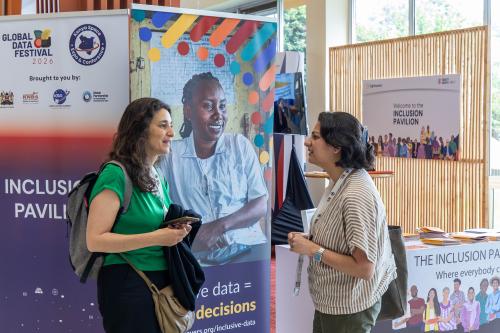
On the ground floor of the Edge Convention Centre, looking out over the green gardens, attendees of the Global Data Festival lingered, conversations started, and curiosity was sparked. The Inclusion Pavilion was open throughout the Festival, and it was nearly impossible to pass it without being pulled in.
Sponsored by Sightsavers and Equality Insights at the International Women's Development Agency (IWDA), the Pavilion was designed to be something different from the main program: not a stage to present from, but a space to think in. A place where the question of who is left out of data, and what the implications are, could be explored.
Over the course of the week, the Pavilion became a meeting place for governments, civil society organizations, researchers, funders, youth advocates, and community leaders to exchange ideas, challenge assumptions, and build new partnerships. Between sessions, visitors gathered around tables, continued conversations over coffee, and connected with people they may never have met in the main conference halls.
Attendance at the Pavilion told its own story: that inclusive data is no longer a side issue. It’s central to how we come together to unlock data’s potential and power. The relaxed setting also encouraged people to ask questions they might not raise in larger sessions, leading to more honest, practical discussions on how organizations can prioritize and work together. Some of the week’s most meaningful conversations happened here, beyond the main agenda and structured sessions, blossoming in the spaces intentionally created for reflection and collaboration.
Read more from the Equality Insights team in their story: The future of data is inclusive.
What gets left out, who gets left behind
Too often, data systems reflect the world as it is recorded, not the world as it is lived. People are left out because of gender, disability, age, geography, often simply because no one designed the system with them in mind. Those gaps shape decisions, policies, and resource allocations in ways that consistently disadvantage the people already most at risk of being left behind.
Better AI, better statistics, better earth observation: none of it delivers if the underlying data doesn't represent the people it's supposed to serve. The systems, structures, and ideas that can deliver more inclusive data are what Sightsavers, Equality Insights, and other inclusion champions brought to the Pavilion.
Inclusion begins with representation. As conversations around AI and emerging technologies continue to grow, we call for stronger investment in disability-inclusive data systems and genuine engagement with disability communities. Because inclusive data creates inclusive futures.
— Caterina Nyambura, disability rights advocate
Read about Caterina's takeaways from the Global Data Festival in her Sightsavers blog.
The writing on the wall
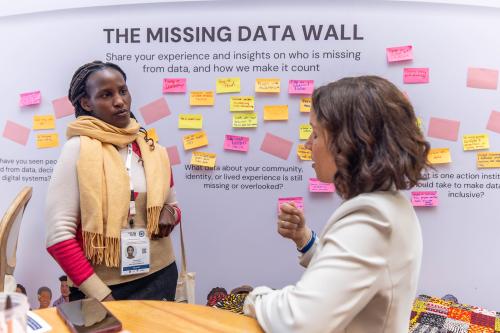
Nowhere was that more visible than at the Missing Data Wall, one of the Pavilion's most interactive features and a constant throughout the four days. Participants were invited to reflect on who is missing from data systems, why they remain invisible, and what it would take to change that. The wall filled quickly with colorful notes naming the groups so often left behind: people with disabilities, women, Indigenous communities, refugees, rural populations, young people.
It became less an installation and more an evolving conversation, a running reminder that behind every missing data point is a person whose experiences and needs risk being overlooked.
Highlights from the week
That same spirit of participation ran through the Pavilion's full program of dialogues, takeovers, design clinics, and flash talks.
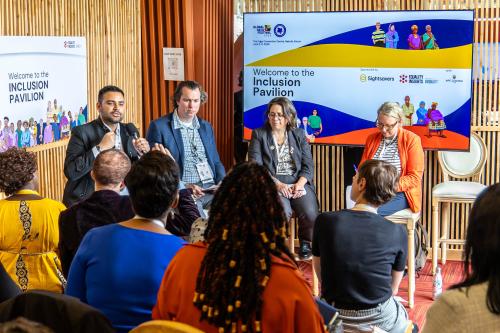
Funding insights, partnership innovation, and storytelling to change the narrative
One of the week's most candid moments came in a panel on inclusive data in a changing funding landscape. Chris Maloney of the William and Flora Hewlett Foundation, Paula McLeod of the UK's Foreign, Commonwealth and Development Office, and Sebastian Sánchez Guerrero of Colombia's Agencia Presidencial de Cooperación Internacional (APC Colombia) didn't soften the picture: the funding environment is difficult, and everyone in the sector is navigating it. But the conversation, facilitated by Pi James of Equality Insights, also pointed toward real opportunities, particularly around better storytelling with inclusive data to shift narratives and build trust across the climate, reproductive equity, and Indigenous rights spaces. The takeaway: despite the challenges, there's a lot to be hopeful about, not least the next generation of data advocates already leading the way.
Meanwhile, a series of sessions showcased the Make Inclusive Data the Norm (MIDN) initiative, a South-South collaboration that brings together governments, national statistical offices, civil society organizations, and technical partners to strengthen the production, use, and governance of inclusive data. Representatives from APC Colombia, alongside partners from Kenya, Ghana, and Colombia, shared how they are advancing more inclusive data systems in their own countries, highlighting innovative approaches, lessons learned, and the challenges of ensuring that no one is left behind in national data systems. The Pavilion also hosted a deep dive into Colombia's inclusive data journey, where government representatives and civil society organizations explored how they are working together to strengthen gender-inclusive data, incorporate community perspectives into decision-making, and build partnerships that make data more representative and responsive. Together, these sessions demonstrated the power of peer learning, South-South collaboration, and cross-sector partnerships in turning inclusive data from an aspiration into action.
The people and communities behind the data
The case for individual-level inclusive data is never clearer than when people get to experience it firsthand, which is exactly what the live Count Me In! card game session offered. Players took on personas and watched how the same event could land completely differently depending on gender, age, and disability. As one participant summed it up: "In early childhood development, we talk a lot about how children learn through play. This is making me realize it's the same for adults too."
In their Pavilion takeover, the iCount Coalition, with the Gender and Environment Data Alliance (GEDA) and Data4Change, invited insights from communities on how they're decolonizing ethical data processes, and an interactive storytelling workshop gave participants concrete tools for turning raw data into a headline and a summary people will actually read. While drop-in sessions with PARIS21 and Open Data Watch looked at the potential of citizen-generated data in inclusive data systems.
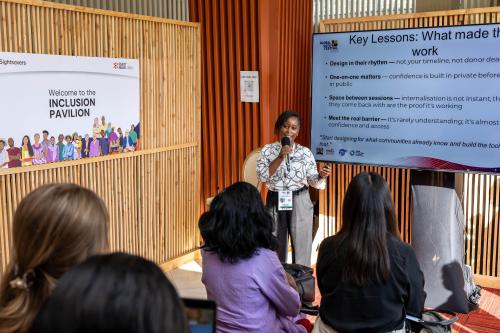
Flash talks by the Global Partnership’s Data Values Advocates shared the projects they have been leading in their own communities, demonstrating how emerging leaders are advancing ethical, community-centered approaches to data through advocacy, research, and innovation. Their stories served as a powerful reminder that investing in inclusive data also means investing in the people who are building more equitable data systems for the future.
A shared responsibility
By the end of the week, one message had become unmistakable: advancing inclusive data is everyone's responsibility, not a job for any single institution. Delegate after delegate asked the same question: "What can we do?" That question, asked by so many people, is itself the answer. More people embedding inclusion into their work is what moves this forward and build systems that represent everyone.
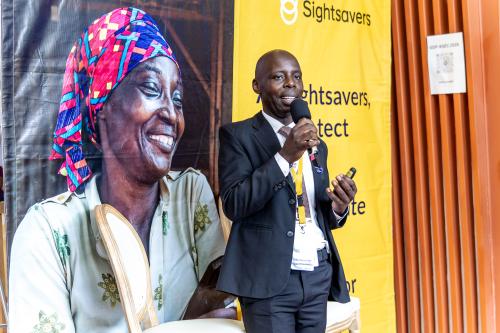
Inclusive Data Charter champions, funding partners, iCount Coalition members, and others shared examples of progress made through collaborations. Sightsavers brought one of the week's clearest illustrations: the use of geographic information systems to tackle trachoma in Kenya, where geospatial tools are helping identify underserved populations, target support more effectively, and strengthen inclusive health delivery on the ground.
Through all the sessions, presentations, and discussions in the Pavilion, it was clear that the key to building more inclusive data systems lies in collaboration across sectors, countries, and communities.
The momentum for inclusive data
The Pavilion carried a sense of collective re-imagining and future-building, with inclusive data as the foundation for creating a more equitable world.
It proved what's possible when governments, civil society, technical partners, and young leaders have a space to learn from one another. Over four days, the Pavilion grew into a hub where conversations sparked new ideas, strengthened partnerships, and turned into practical action on inclusive data.
As the final day came to a close, the Pavilion screens were turned off, the signs came down, and space on the ground floor of the Edge was converted back into a lounge by the window.
But the conversations that started there are only just beginning.