"80% of young people in Madagascar are unemployed. Is that true?"
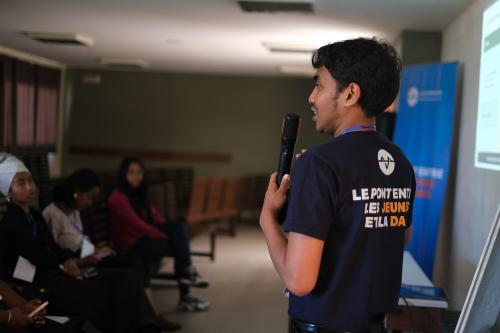
That was the exact question I chose to open my remarks during the Youth Plenary at the Global Data Festival 2026. Not because I had the answer, but because I wanted to make a point. We hear numbers every day from politicians, the media, and social media, yet we rarely stop to ask: Is this true?
I am Mirado Rafenomahenintsoa, a data educator, founder of DataBridge Madagascar, and a Data Values Advocate. I have long believed that everyone should have the skills to question data, not just experts. The Data Values Project gave me the opportunity to put that belief into practice.
As I began working on the project, I realized something about myself. Even though I work with data every day, I wasn't always asking the right questions when I encountered public numbers. If I sometimes took statistics at face value, how many others were doing the same?
That question also reflects a broader shift in how young people encounter information. According to the Reuters Institute's 2026 Digital News Report, 52% of 18–24-year-olds globally now say social media, video networks, and AI chatbots are their main way of getting news.
This is what inspired me to create Marina ve?, meaning "Is it true?" in Malagasy. Instead of teaching advanced statistics or professional fact-checking, the project focused on one practical skill: helping young people verify public numbers.
DATA: a framework for asking the right questions
To help participants put this into practice, I developed DATA, a simple framework for questioning public numbers built around four steps:
- Decode the claim
- Analyze the context
- Trace the source
- Act responsibly
Rather than telling participants what to think, DATA gives them a structured way to think through public numbers. Its simplicity was intentional. In the context we work in, complexity often discourages participation. The goal was never to turn participants into fact-checkers, but to help them ask better questions and understand what the available evidence can, and cannot, support.
Working with Factivistes, a Madagascar-based fact-checking initiative, and nine youth organizations across Antananarivo, we also produced a citizen guide to public data sources in Madagascar. After all, asking better questions only matters if people know where to find reliable answers. Together, the workshops and the guide reflected the principles of accountability, transparency, and data literacy at the heart of the Global Partnership's Data Values Manifesto.
Putting ideas into practice
Our first workshop, held on May 9, 2026, brought together 22 participants aged 18 to 30. Confidence in verifying public figures' statements increased from 2.2 to 4.5 out of 5. Among those who responded to the post-workshop survey, 85% said they intended to use DATA within the following week, while 92% said they would recommend the workshop. We also produced a two-minute mini-documentary capturing the experience.
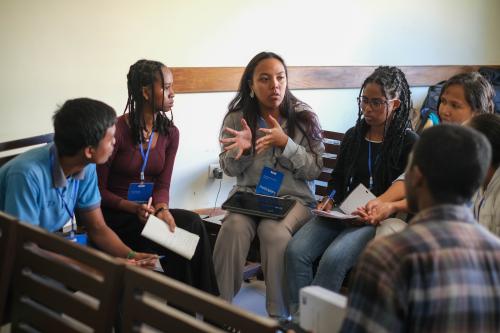
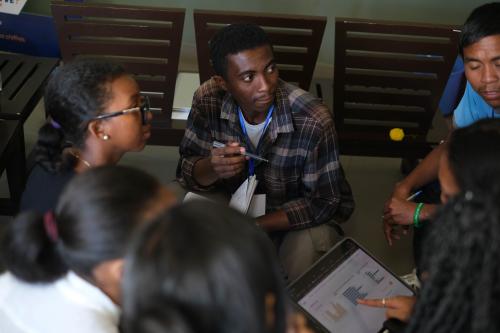
The survey results were encouraging, but they were not what stayed with me. During a group exercise, participants analyzed the same youth unemployment claim. They challenged assumptions, searched for evidence, and debated their findings. Their conclusion was not "true" or "false," but something more valuable: here is what we can say, here is what we cannot say, and here is where the available evidence ends.
That distinction changed how I think about data literacy. We are not teaching people to declare what is true. We are teaching them how to reason responsibly when the available evidence is incomplete.
For me, that is what data literacy looks like: not accepting public numbers at face value, but asking better questions before accepting them.
The journey from Madagascar to Kenya, and what's next for DataBridge
Beyond supporting the project, the Data Values Advocates program changed how I approached it. My mentors, Benedetta Veneruso (program alumni) and Mariana Rozo-Paz, encouraged me to resist the temptation to do too much and instead focus on doing one thing well: helping young people verify public numbers. They also encouraged me to structure the learning journey, inspiring me to develop DATA as a framework participants could easily remember and apply. Looking back, that advice shaped more than this project. It influenced how I now design educational initiatives at DataBridge Madagascar: start with one problem, make it practical, and build from there.
The program also connected me with advocates tackling different challenges around the world, united by a shared belief that data should serve people. Meeting them in person at the Global Data Festival 2026 in Nairobi was one of the highlights of the experience.
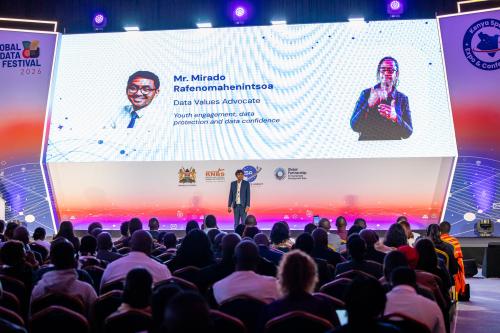
Representing Madagascar, I was reminded that conversations about data values matter just as much in countries where data ecosystems are still developing. Beyond the Youth Plenary, I met practitioners tackling challenges similar to ours, and I returned home with new ideas, new collaborations, and renewed confidence that Marina ve? is part of a much larger global movement.
Those conversations reinforced something important: Marina ve? should not end with a single workshop or with the end of this program.
We are now developing self-paced e-learning modules for the DataBridge Learning Hub, with the goal of reaching 600 learners by the end of 2027. We also aim to deliver 10 workshops reaching 250 young people in three regions of Madagascar, expanding beyond Antananarivo.
Because advancing data values does not begin with better technology.
Sometimes, it begins with a simple question: Marina ve? ("Is it true?")
-------------------
We believe verifying public numbers should be a citizen skill. If you share that belief, we'd love to continue the conversation. You can reach me at [email protected]. To learn more about the project and the work of DataBridge Madagascar, visit databridge.mg.