I’m Mexican, and for the past six years I’ve dedicated myself to defending the rights of young people in Mexico, specifically within the Youth, Peace and Security (YPS) agenda, the global policy framework established by the UN in 2015, which recognizes young people as active agents of change for building peace. Over the years, I’ve come to realize how important data is, not only for tracking progress through statistics, but also for improving youth-led strategies, plans, and projects year after year.
The missing measurements
Mexico is a young country, with 30.4 million people between the ages of 15 and 29, nearly a quarter of the population. Yet when we talk about young people in my country, the conversation tends to focus more on our problems than on our contributions. We know how many young people are victims of crime, as well as how many are drawn into organized crime. We hear about the lack of job opportunities and financial uncertainty, but we rarely talk about the young people who organize, participate, and work to build peace in their communities.
The Youth, Peace and Security (YPS) agenda changed this perspective by recognizing young people as actors in peacebuilding, not as recipients, but as key drivers of change. And while there has been significant progress in the more than 10 years since the agenda was established, we still need better ways to measure the everyday work of the young people and organizations already building peace: how the agenda is being put into practice by them, who is driving it and where, and what results their efforts are achieving.
Building a way to make it count
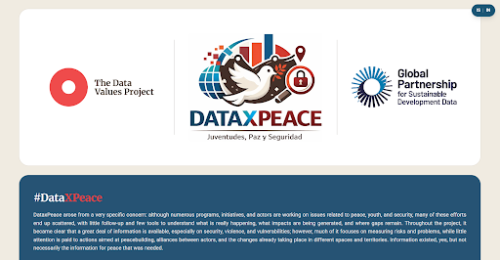
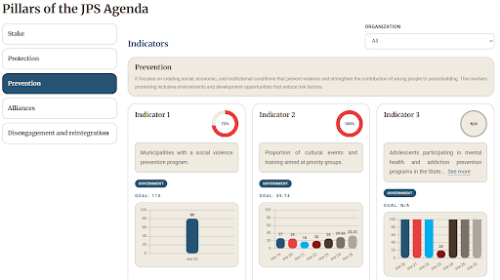
That’s where DataxPeace comes in. My Data Values Advocate project—of which I am very proud—is the only publicly available tool that demonstrates and measures progress on the YPS agenda in Mexico. Aligned to the five pillars of action: participation, protection, prevention, partnerships, and disengagement, it captures the efforts of key actors such as civil society, government, universities, international organizations, and the private sector.
The goal is not just visibility. It’s to make progress measurable so we can analyze what is working, what isn’t, which sector needs to do more, and which pillars require greater focus so that stakeholders can build a shared strategy to advance the agenda together.
|
|
The tool began with government indicators drawn from existing open data in Mexico. There were only a few of them, but they were a good starting point. Since then, I have worked with 10 youth civil society organizations, through two training sessions and three follow-up meetings, both synchronous and asynchronous, involving 30 young people. Together, we explored issues such as how to measure people’s sense of peace in their communities and how to capture the level of youth engagement in different initiatives.
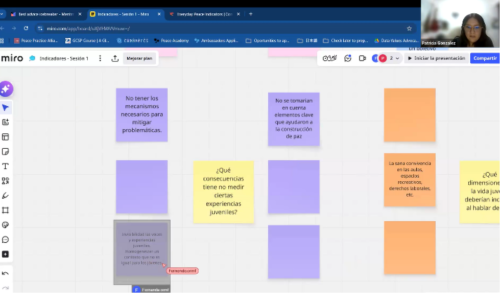
During these sessions, we stopped asking only what data already existed and started asking a different question: What are we missing? Our conversations showed how difficult it can be to capture youth-led peacebuilding through conventional indicators. Much of this work happens through relationships, community organizing, prevention, and trust built over time—things that do not easily translate into numbers and statistics.
One participant put it in a way that stayed with me: “We do this work every day, but we don’t always know how to show it through data.” From these conversations, we co-designed five new indicators that aim to better reflect the realities and priorities of youth organizations. For me, this process confirmed that measuring does not have to mean reducing youth work to a number; it can also be a way to recognize it, make it visible, and ensure that it is taken into account in decision-making.
Crediting the changemakers
The tool has been well received, particularly by youth civil society organizations, who not only find it useful as a tool to measure progress, but also appreciate the platform for acknowledging their work. As a member of a youth organization and as a young person myself, it was important to me that the tool served as an example of the initiative and capability of young people to successfully lead projects that would normally be carried out by the government agencies with significantly more financial and technical resources.
Beyond its role as a measurement tool, DataxPeace is becoming a space for recognizing the work young people are already doing in their communities. In conversations with participating organizations, one of the things I have heard most often is that having a space to make their efforts visible also helps show that peacebuilding does not happen only within institutions, but within communities themselves. For me, that recognition is just as important as the data: Behind every indicator are young people who are giving their time, skills, and energy to transform their communities.
What being a Data Values Advocate means
Joining the Data Values Advocate program has defined my career path and will likely continue to do so, as it has shown me the relevance of data in every aspect of my life and its positive and negative impacts. It helped me to understand that if we do not question the data—and, above all, the systems that generate it—we are complicit in the systematic exclusion of people, contexts, and ideologies different from our own. That is why today, as a data advocate—having received training and mentorship—I feel a responsibility to broaden my perspective, provide tools to those who lack them, and demand that those who possess the data and resources share them with those of us who generate them.
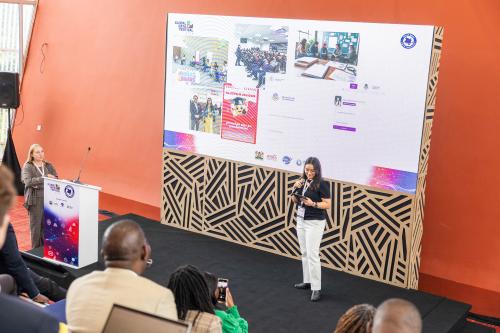
The Global Data Festival represented both a conclusion and a new beginning for me. Although it marked the end of the Data Values Advocate program, it also allowed me to hear others’ experiences working with data in completely different fields, from nonprofit organizations working with people with disabilities to organizations focused on space, health, and sustainable development. In the end, we were all united by a shared conviction that data matters. It showed me that although we come from different fields, we can share knowledge that applies across all our work. I left the event having made valuable connections with stakeholders from around the world. These people I remain in contact with, and I am certain will provide me with important guidance as I continue on my journey advocating for the value of data.
The next question
As I finish up my time in the Data Values Advocate program, I’m excited for what comes next. The DataxPeace project is growing; we are currently in discussions with more youth organizations who want to help analyze and develop indicators to enhance the impact of their peacebuilding work. Recently, the Observatorio de Juventudes Unidas por la Paz, the organization I am part of, received funding from the Peace Development Fund to continue improving the tool. This will help improve the quality and quantity of the information it provides and, above all, to bring the tool closer to decision-makers so that the data we generate can meaningfully contribute to policy planning and design.
Our goal this year is to establish at least 10 civil society indicators and begin conversations with youth civil society organizations in other states across Mexico to explore how their data and experiences can also be incorporated into the tool. For me, this is an important next step: making sure that DataxPeace does not only show what young people are doing, but helps that work reach the people and institutions in a position to support and build on it.
DataxPeace began with a simple question: What are we overlooking when we fail to measure the work young people are already doing? Now, I want to take that question a step further: What will we do with what the data is showing us? I hope that young people and youth organizations continue to document, share, and make visible the work taking place in our communities. But I also hope that governments, decision-makers, funders, universities, and other institutions recognize these efforts not as something extra, but as part of the existing peacebuilding work that deserves support.
Measurement is just the first step. The real challenge lies in turning what we learn into recognition, resources, better decisions, and genuine opportunities for young people to continue leading change. After all, young people are already building peace in their communities. Now, it is up to all of us to ensure our work is seen, valued, considered, and above all, put into action.