
This article, by Winnie Kamau, is part of the series of stories from the Global Data Festival and Kenya Space Expo & Conference by journalists in the Open Data Watch-Data2X media fellowship program.
The Global Data Festival held in Nairobi in June served as a melting pot of conversations on the future of data, where I had the opportunity to attend the lightning talk by Riana Bucceri. As a Data Values Advocate and Assistant on the Data & Analytics team at the Open Government Partnership, she brought a stark accountability gap to light using a newly showcased tool. Before revealing a single data point from this new transparency tool, she challenged the audience to do something uncomfortable, prompting them with a powerful question: what really breaks a corruption story?
"I'd like you all to think of a recent headline or a scandal related to corruption that you read. Maybe it was one that happened more recently. Maybe it's one that happened years ago but has just kind of stuck with you,” Riana asked.
She gave the room a moment. Then she pushed further. “Do you know what exactly brought that corruption to light?”
Her answer was simple, and it landed with quiet force: "It was ultimately the data that broke the story."
The number that shouldn't be abstract
Bucceri opened her lightning talk with a figure that is easy to read and hard to absorb: $3.6 trillion. That is the estimated annual cost of corruption globally.
"The opportunity cost of that in our communities is schools that are left unbuilt, infrastructure left unmaintained and unbuilt, and aid left unprovided. That level of corruption is perpetuating harm in our communities, and that theft is real, even though the number sounds inflated and maybe intangible,” she said.
She wanted the number to feel tangible. And to do that, she reached for one of the most infamous corruption exposés in recent history.
The lesson of the Panama Papers
Ten years ago, a coalition of investigative journalists from around the world working with a massive leaked dataset revealed a sprawling network of anonymous shell companies and offshore accounts used to conceal wealth, obscure ownership, and in many cases facilitate corruption and crime on an industrial scale. The Panama Papers named elected officials. It exposed financial structures that had operated in plain sight, hidden only by the absence of publicly available ownership information.
"This transparency, and having information on who the real or beneficial owners of companies are… is so important to deter corruption. This kind of information can prevent money laundering, conflicts of interest, improperly awarded government contracts, and tax evasion. And with this level of transparency comes accountability,” noted Riana.
The Panama Papers did not happen because of a lucky guess or a single whistleblower acting alone. It happened because the specific, structured, traceable data was finally made visible. The question Bucceri brought to Nairobi was: how many countries are actually making that kind of data visible today?
The tool and the numbers it revealed
To answer that question, Bucceri and her colleagues at the Open Government Partnership built an online tool which compiles third-party datasets to give users a clear, accessible, and objective view of the state of open government at a global level — tracking indicators across beneficial ownership transparency, civic space, public participation, fiscal openness, governance, and access to information.
"We wanted to focus on indicators that would provide accessible, objective, and actionable insights. And we also wanted to have a country-level interface where you could see how countries are doing in adopting different measures of open governance and where countries aren't meeting them, and provide them with recommendations they could take action on,” said Riana.
The wider gap behind the numbers
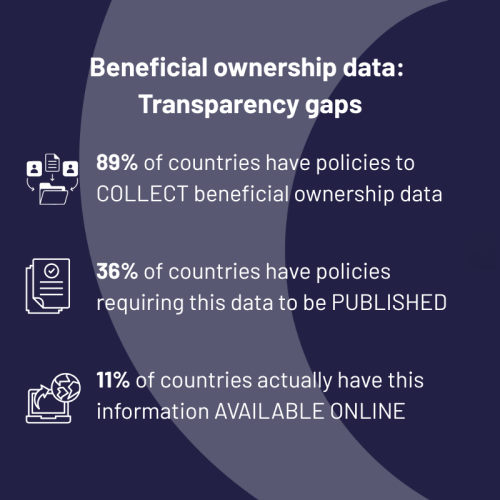
Bucceri was careful to make clear that beneficial ownership data is not an isolated problem. It is a window into a systemic one.
"So we have 89% of countries saying they will collect it, but it is actually not available online for the vast majority. What this shows is an implementation gap in these policies. And where there are gaps in implementation, there are gaps in accountability,” explained Riana.
Adding, "If there are gaps here in beneficial ownership transparency, are there possibly similar gaps in other areas of open government? Budget transparency? AI regulation? There's really no limit to where these implementation gaps could lie. That is why we created this tool to help people identify them and advocate to their governments for reforms,” she said.
The tool is still in development and not yet publicly hosted, but Bucceri made clear her intention to make it freely and openly accessible. In the Q&A, she invited anyone interested to see a live demo and offered to gather feedback before the tool's public launch.
Communities, soft power, and the accountability gap
When the lightning talks concluded and the Q&A session began, an audience member raised one of the day's most profound questions: how can communities practically hold governments accountable to their promises? Bucceri avoided offering any easy or comfortable reassurances.
"Open government is really all built around transparency, participation, and accountability. We work with civil societies and try to empower them to work with their governments to promote those values. But there are obviously gaps in what we're able to actually enforce” explained Riana.
Riana also acknowledged the tension directly and without euphemism, noting that there is often political resistance to major reforms. “But I think trying to raise the global norm of integrating open government values in our communities can hopefully make that impact in sustaining accountability in a broader sense" she said.
It was a frank admission one that the audience clearly appreciated. The Open Government Partnership's power, she was saying, is ultimately normative. It works by raising expectations, documenting challenges and gaps, and equipping civil society to push back. It does not have enforcement teeth. But it has data. And as the Panama Papers demonstrated, data placed in the right hands, made public at the right moment, can do what no enforcement mechanism can.
The next corruption headline you read
Bucceri closed her talk the same way she opened it with an invitation to think differently about the corruption stories that surface in the news.
"Next time you see a corruption headline, don't just roll your eyes as I do very often. Think about the data that was behind that article. What brought it to light. Maybe you'll even think about this tool, or be prompted to use it."
Adding, "But ultimately, I want to remind you of the importance of this data to promote transparency, accountability, and good governance."
The applause that followed was warm and immediate. In a week full of conversations about data's power to transform lives, Bucceri had offered one of its most urgent applications: not just building economies or improving services, but exposing the forces that steal from them.
