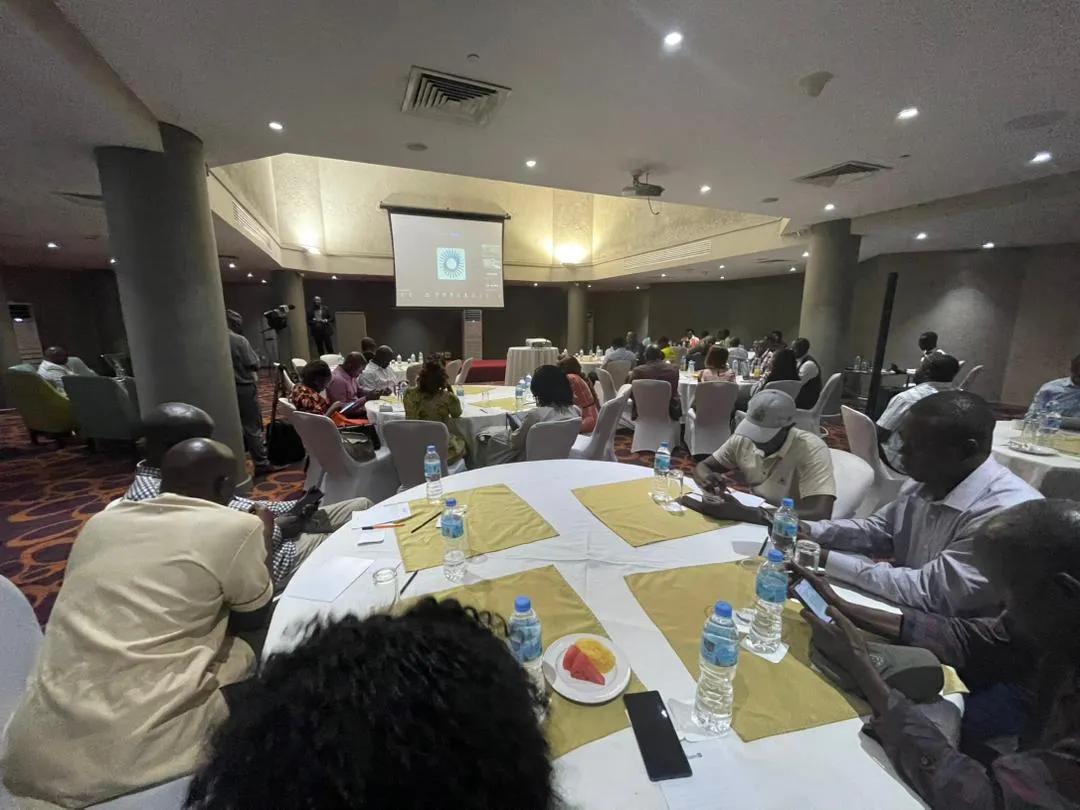
Sierra Leone has taken a significant step toward transforming its agricultural sector and advancing food security by improving data quality. On November 25, 2025, the Government officially launched the national initiative on Strengthening Agricultural Data and Data Use for Policy (AgriData-SL), marking the start of a coordinated effort to modernize the country’s agricultural data ecosystem. The initiative is anchored in Feed Salone, CAADP, the 50x2030 Initiative, and the Medium-Term National Development Plan, and is supported by the Gates Foundation, the Islamic Development Bank, and the Global Partnership.
Agriculture remains a priority for Sierra Leone. Yet fragmentation across data systems, duplication of efforts, limited real-time insights, and uneven analytical capacity continue to hold back progress. Through AgriData-SL, government institutions and development partners are working together to change this. The Ministry of Agriculture and Food Security (MAFS), Ministry of Planning and Economic Development, Statistics Sierra Leone, IDinsight, the ATO, and other partners are aligning around a shared vision: a stronger, more connected, and more routinely used agricultural data system that informs policy and investment.
Data must drive decisions
At the launch, Dr. Henry Musa Kpaka, Minister of Agriculture and Food Security, underscored the government’s commitment to using evidence to guide action. He emphasized that the value of data rests in how it informs learning, scaling, and policymaking. “Data for reporting sake is only as good as the report itself. What matters is how you use it to learn, replicate success, and scale interventions for bigger impact.”
Drawing on recent assessments conducted with national institutions, including Statistics Sierra Leone, SLARI, and NaMED, the Minister noted that Sierra Leone has strong foundations to build on. These include geospatial analysis capabilities, nationwide survey infrastructure, and established monitoring systems. He highlighted ongoing reforms, including the establishment of an Annual Production and Yield Survey, scheduled for release every March 15, which strengthens the Ministry’s role as a reliable source of agricultural statistics.
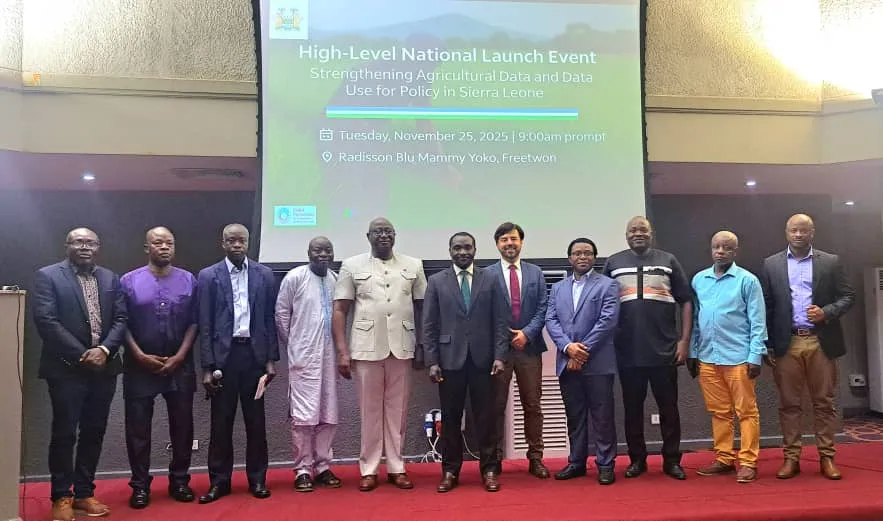
Looking ahead, the Minister outlined priority actions: activating the agricultural data working group, improving standards and data-sharing protocols, enhancing interoperability across platforms, upgrading mapping and visualization systems, and leveraging national farmer registration to improve planning and service delivery.
Development partners reaffirm support
Representing the Gates Foundation, Julianna Drinan, Senior Program Officer, Agricultural Development, commended Sierra Leone for shifting from data collection to purposeful data use, which she described as the next frontier for maximizing impact. She emphasized the importance of reducing fragmentation and strengthening alignment across institutions to increase the value of national systems.
From the Islamic Development Bank, Dr. Areef Suleiman, Group Chief Economist, underscored that reliable data is now central to effective agricultural policy, food security planning, climate resilience, and crisis response. He welcomed the AgriData-SL platform as a strong model that brings together government, partners, research institutions, civil society, and private sector actors to guide strategic data investments. He reaffirmed the Bank’s commitment to supporting interoperable, technology-enabled data systems and embedding data into budgeting and monitoring processes.
Laying the foundations for a stronger system
During the technical session, the Global Partnership shared seven “transformers” that will be essential for success:
• strengthening legal and policy frameworks for data governance and institutional coordination
• identifying priority indicators and aligning them with data sources
• mapping and integrating systems across the sector
• improving interoperability
• building analytical and geospatial capacity
• embedding routine data use in decision-making
• institutionalizing data in national planning and reporting processes
These elements will help Sierra Leone move from fragmented data efforts to a connected, efficient, and policy-driven ecosystem.
A regional model in the making
With committed leadership, clear national priorities, and strong partner alignment, Sierra Leone is well-positioned to become a regional example of how countries can leverage agricultural data to strengthen food security and drive development.
The Global Partnership and other partners will continue supporting the country through AgriData-SL and related capacity-building and governance efforts.
Initiatives

Agriculture data to tackle food insecurity

Power of Data: Unlocking the Data Dividend for the SDGs