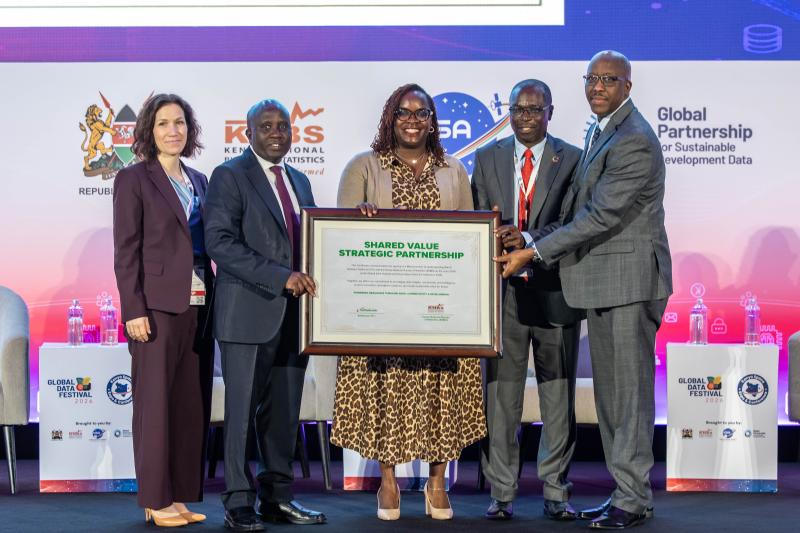
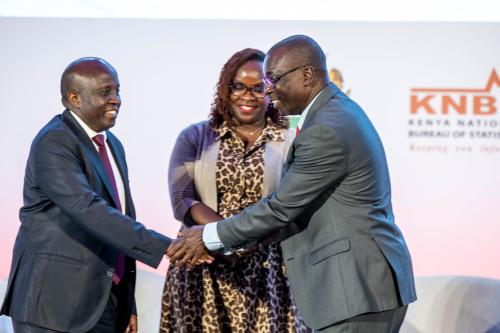
After much anticipation, On 4th May 2026, Dr. Macdonald Obudho, Director General of the Kenya National Bureau of Statistics (KNBS), signed a strategic partnership with Safaricom PLC , to explore the use of mobile data insights, beyond what is collected by the government. It will bridge critical information gaps for policy development and national planning, delivering one of the most significant data partnerships in Kenya's statistical history.
The official announcement came at the 2026 Global Data Festival and Kenya Space Expo & Conference in Nairobi, where more than 1,300 data scientists, policymakers, statisticians, and technology leaders had gathered. When Dr. Obudho finally took to the stage, the room understood immediately that something significant was about to be announced.
On the 4th of May 2026 the KNBS signed a strategic partnership with Safaricom PLC to explore the use of mobile data insights, beyond what is collected by the government to help us gather crucial data for official statistics. We have waited five years for this moment. We gathered the world together to witness how we walk into this space.
Dr. Macdonald Obudho, Director General, KNBS.
The applause that followed was not merely polite. It was the sound of a community recognizing that something that had once seemed impossibly distant had finally arrived.
From pilot to partnership
The partnership between KNBS and Safaricom PLC did not happen overnight. Dr. Obudho traced its origins back to a 2016–2018 International Telecommunication Union pilot project in which Kenya was selected alongside the United Arab Emirates, Georgia, Colombia, South Korea and the Philippines to test the use of mobile phone data for measuring the information society. The verdict of that project was that Kenya was ready to use mobile data.
From there, Kenya attracted World Bank support in 2024, joining the first cohort of the Global Data Facility's initiative on putting mobile phone data insights to work for policy. But translating readiness into a live partnership with a mobile network operator proved far harder than anticipated. Credit for finally bridging that gap went to the Global Partnership for Sustainable Development Data and its CEO Jenna Slotin, the World Bank, as well as the Flowminder Foundation, which walked the journey with KNBS through every setback and delay.
The power behind the partnership
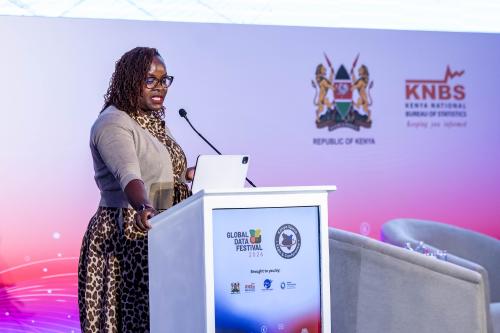
Taking to the stage after the announcement, Karen Basiye, Director of Sustainability and Shared Value at Safaricom, grounded the moment in a story that illustrated the place of mobile data insights in helping bridge critical information gaps in key sectors such as healthcare, agriculture and climate adaptation.
Twenty years ago, we piloted a product to help a group of women make microfinance loan payments in Thika. On observing their payment trends, , the data showed that people were not only using this platform to repay loans, but also using it to send money to each other. Turning M-Pesa into a digital wallet.
Karen Basiye, Director of Sustainability and Shared Value, Safaricom PLC
Safaricom’s Fintech strategy is in itself built on data insights. When data showed that business payments were being directed to individual wallets, Lipa na Mpesa was born. When transaction data revealed that millions of Kenyans were abandoning purchases because they were a few hundred shillings short, this gave rise to Fuliza, from the Swahili word meaning to push through or complete, proof that insights fuel innovation.
"This is what data for good looks like. Turning friction into opportunity and failed transactions into financial empowerment. Today, over 40 million customers use M-PESA monthly, which translates to Forty million stories of impact." noted Karen. "At Safaricom, Trust is not a byproduct, it is the foundation of our operations and also within the framework of Kenya's Data Protection Act. We embed privacy by design, prioritize anonymization and data minimization, innovating in respect of the individual rights of our customers.".
Kenya's Principal Secretary for ICT and Digital Economy, Eng. John Tanui, added the policy dimension, noting that Kenya's frameworks are now mature enough to contemplate a major international milestone, "Kenya possesses constitutionally grounded access mechanisms, independent accountability institutions, and robust judicial oversight structures to safeguard against arbitrary and unlawful surveillance." he said. A signal that Kenya may be on the verge of becoming Africa's first country to receive EU data adequacy status unlocking secure cross-border data flows with one of the world's largest economic blocs. Eng. Tanui was equally firm on principles:
Data sharing frameworks must embed privacy, cybersecurity, and ethical safeguards from the onset rather than as afterthoughts. Equity and inclusion are key for marginalized populations and must be represented in data sets and must benefit from data-driven innovation.
The practical power of mobile data insights
Dr. Obudho offered one of the most compelling illustrations of what this partnership will actually make possible drawing on something every Nairobi resident instinctively understands.
"Our census is a de-facto census, you are counted as per where you spent the night. That gives us Nairobi's population at night: 4.41 million people in 2019. But look at the day's population. Kiambu, Machakos, Kajiado are the bedrooms for Nairobi. Millions of people live outside its boundaries but come to work inside it every day." explained Dr. Macdonald Obudho.
The implications are enormous. Statistics built only on night populations systematically undercount the demand on roads, hospitals, water systems, and emergency services during working hours. Mobile phone data insights can fill that gap.
Getting the day's population will be very important. That is not limited to even helping us with the traffic jam that we are witnessing. Which roads are having what, and to what scale? What is coming in, what is going out? That would help us design our roads and help us in emergencies whenever they occur.
Dr. Macdonald Obudho, KNBS
Trust, transparency, and the groundnut parable
The partnership announcement was the centerpiece of a broader panel, 'Data Silos to Ethical Insights: Balancing Value and Privacy', moderated by Victor Otieno, Managing Director Viffa Consult, who opened proceedings with a provocation that set the tone for everything that followed, "He who peels groundnuts for a blind man must keep whistling to prove he's not eating the groundnuts. The conversation is around trust. If you forget anything from today, please remember the problem."
The panel brought together Sharon Holi, Head of Customer Privacy, Safaricom PLC, Esperanza Magpantay, Senior Statistician, International Telecommunication Union and co-lead of the ITU-World Bank Global Data Facility Initiative, Josh Powell CEO, Development Gateway: an IREX Venture, and Abbas Jah, Manager for Urban & Disaster Risk Management, World Bank Group. What followed was a frank, expert, and refreshingly candid conversation about why data so rarely moves and what it takes to make it flow.
Abbas Jah delivered the panel's most quotable line, cutting through layers of technical discussion to name the real obstacle with blunt precision, "Data doesn't get stuck on servers. It gets stuck in institutions."
The barriers, he argued, are rarely technical. They are human rooted in political economy, institutional inertia, and a fundamental absence of trust between the organizations that hold data and those who need it. Abbas Jah noted, "Ministries and agencies do not want to share data. So typically you want to pitch this at a very high level from the prime minister's office, or the president's office should be leading this initiative. Singapore took close to a decade to set up their data exchange. It is not an easy task."
Building trust you can see, feel, and touch
Sharon Holi pushed back gently on the idea that trust is primarily a governance or legislative challenge. In practice, she argued, trust is built in the small moments in how an organization handles people's data, not just what it says about it.
Trust is like your personal relationships - you need to see it, you need to feel it, you need to touch it. Are we talking enough about how we take care of you? Give your customers a reason to believe. Make sure it's built into your customer journeys. Make sure it comes alive when they interact with you as an organization.
Sharon Holi, Safaricom.
She cited Safaricom's recent introduction of data minimization on person-to-person M-Pesa transactions as a direct example, a change driven by customer feedback where recipients were using sender information to make follow-up requests for money.
Abbas Jah pointed to India's Aadhaar biometric system as a model of privacy built into architecture rather than bolted on afterwards.
Trust should not depend on you and I being friends. It should be built into the structure. If you have my US social security number, you can do a lot of damage. If you have my Aadhaar number, it really doesn't matter. We need to design systems around privacy and Africa has a great opportunity right now, because many of these systems are still being designed.
Abbas Jah, World Bank group
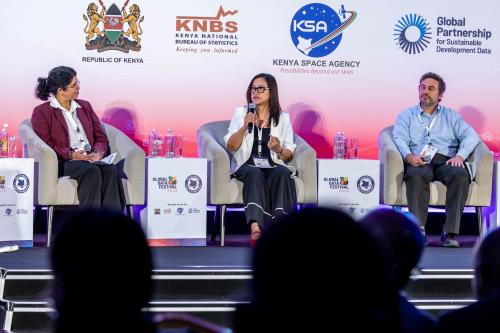
Esperanza Magpantay brought the technical lens, explaining that the International Telecommunication Union (ITU) is currently developing a mobile phone data governance framework specifically designed to address trust as its central pillar.
Privacy by design is a key component starting with privacy-preserving techniques and anonymization methodologies to ensure you don't release information, even at aggregated level, that can pinpoint back to individuals. Trust is the main component that is important for these projects to succeed in countries.
Esperanza Magpantay, ITU
Start with the problem, not the technology
Josh Powell offered a challenge to the room that applied as much to governments as to development organizations: be ruthlessly specific about what problem you are actually trying to solve.
Very often where we see initiatives struggle is where the problem definition is 'we need better data sharing' and when you ask why, someone says 'for better agricultural development.' That's probably not specific enough to generate action. Where we see more success: 'we need better data sharing because we need to drive down the cost and increase the availability of quality fertilizer for smallholder farmers at the right moment in the planting season.' Those kinds of specific questions galvanize action.
Josh Powell, CEO, Development Gateway and IREX Venture.
He pointed to concrete examples where this approach had taken root and held, including Kenya's Presidential Economic Transformation Secretariat consulting shared data to design a $100 million fertilizer subsidy program, a Senegal meteorological-agriculture data collaboration still expanding years after its initial launch, and a complex Ethiopian livestock data initiative spanning multiple ministries now unlocking disease-free export zones and improving vaccination campaigns. "The systems and data sharing agreements that are still in place five or ten years after a program has ended are the ones where the bureaucracy itself sees the value and ultimately becomes the one selling the idea when a new permanent secretary or minister comes in." explained Josh.
The real use cases are already here
When the moderator asked for practical examples of data producing real development outcomes, the panel did not struggle for material.
Abbas Jah highlighted Togo's novissi program during COVID-19 where satellite imagery and mobile phone data combined to rapidly identify and reach half a million vulnerable citizens with social safety net payments, operating entirely on 2G networks, "We get really caught up with the technology and the next shiny new thing. But you need to start with the problem definition first. And the solution has to be appropriate to the context in which you are operating."
Josh Powell celebrated Estonia's X-Road e-government platform, built on the principle that a citizen who provides data once will never be asked for it again and pointed to Singapore's MyInfo consent-based verification system, which saves banks an estimated $50 per KYC transaction, "If you can bring the private sector in saying 'this system will save you $50 per transaction,' they will be firmly behind it. You need to build a coalition of support around data sharing protocols and the private sector is a very big part of it."
Esperanza Magpantay noted that countries across Africa, including Botswana, Ghana, Gambia, and now Kenya are already seeing the results of mobile phone data partnerships:
We have seen an explosion in the use of mobile phone data because partnerships enable them. Countries can only achieve this if all stakeholders, government agencies, sector ministries, the private sector, data protection agencies, international organizations are sitting around the same table.
Esperanza Magpantay, ITU.
A partnership that can transform Kenya
As the session drew to a close, Victor Otieno pressed the panel on what practical partnerships they are looking forward to pushing back against the risk of conferences that produce inspiring conversation and no follow-through, "without practical, meaningful partnerships that you are looking forward to, you have just wasted saliva."
For Karen Basiye, the KNBS-Safaricom partnership is critical in advancing policy development for economic growth, borne of the Safaricom Foundations’ reliance on KNBS population and health data to guide its shared value investments.
We are excited about this partnership. When you design with people in mind and protect their data, innovation becomes inclusive, trust is built, and lives are transformed. We are committed to being Africa's leading purpose-led technology company by 2030 and this kind of collaboration will play a big role in that transformation.
Karen Basiye, Safaricom.
For Dr. Obudho, the destination has always been clear in getting Kenya to the level of the countries that have mastered the responsible use of mobile phone data insights for public policy and national development.
My wish is not for Obudho the person to get there. It is for Kenya as a country. And we now have the foundation to move very fast. We are ready.
Dr. Obudho, KNBS
This article, by Winnie Kamau, in collaboration with representatives from Safaricom PLC and the Kenya National Bureau of Statistics, is part of the series of stories from the Global Data Festival and Kenya Space Expo & Conference by journalists in the Open Data Watch-Data2X media fellowship program.