
In Uganda, health facilities in humanitarian settings depend on one basic logistical question. Will the medicines and supplies be there when people need them? Gideon Abako, who led the Uganda project as Principal Investigator and Programme Manager, has been trying to answer that question with AI. He presented the work, "Designing AI for Government Adoption in Crisis-affected Health Systems," as a lightning talk at the Global Data Festival and Kenya Space Expo & Conference 2026 in Nairobi.
Gideon set out to explore how AI could improve forecasting, helping health facilities anticipate the medicines and supplies they would need in humanitarian settings. The project, supported through Elrha’s Humanitarian Innovation Fund with funding from the UK Foreign, Commonwealth & Development Office (FCDO), "quickly taught us that forecasting was only one part of the problem," he says. Connectivity was unreliable, systems were fragmented, and infrastructure was thin. The team also had to account for the institutional, technical, and financial conditions needed for government to sustain new technology after external support ends. Gideon’s team built around those limits with an offline-first architecture and a three-tier forecasting approach. In humanitarian settings, a disrupted supply chain has serious consequences for the people who depend on it, health workers and the communities they serve.
Since the Festival, that work has kept moving toward operational piloting. Gideon and his team now have a validated framework and a strengthened technical architecture. Conversations continue about how the approach can work within existing government systems. For him, the real test is whether the system can hold up inside "the institutional and operational realities of government."
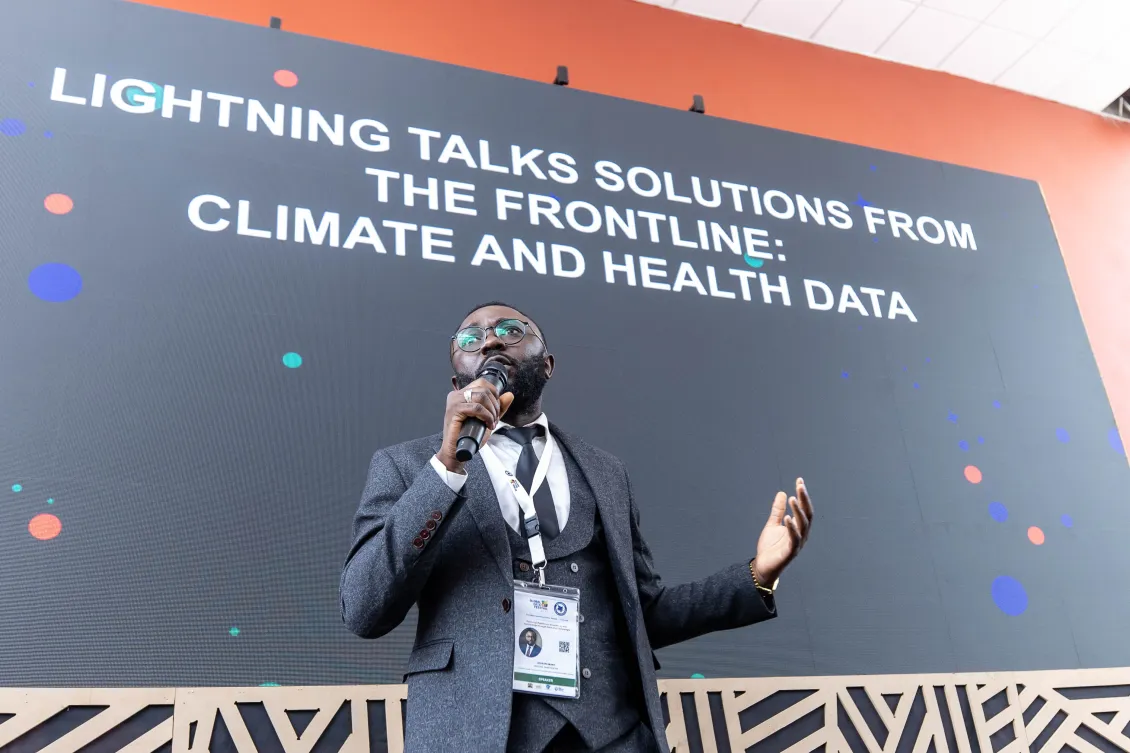
The Festival gave him a few new threads to pull on, conversations about responsible AI, government adoption, and data infrastructure, and what he called "the gap between what technology can theoretically do and what institutions can realistically sustain." Since then, he's talked with people outside health care too, interested in how some of the same lessons could apply beyond health supply chains.
The reaction that stayed with him most was the interest in the tension between innovation and government adoption. As technologists, he says, people tend to focus on accuracy, performance, and what a system can do. Governments ask different questions, on affordability, maintenance, interoperability, and ownership once a project ends. "Building better models is only part of the work," he says. "We also have to design for the institutions that will have to live with them."
