Unlearning assumptions: How communities are redefining official statistics
The recognition of citizen data as vital rather than supplementary has been advanced by communities such as the National Conference of Afro-Colombian Organizations. At the Tumaco workshop, for example, these groups spoke plainly about having to lift their own information specifically to refute institutional data that they felt was erasing them. This was not a request to be included in existing frameworks; it was a challenge to the frameworks themselves. This prompted DANE to re-evaluate the standards used for data validation, particularly the focus on urban contexts over rural realities. Similarly, through discussions on vital statistics in Chocó, where traditional data collection methods encountered challenges related to infrastructure and territorial accessibility, the Partera Vital pilot demonstrated that simple data can be gathered effectively using basic tools like WhatsApp.
To adapt these insights, DANE implemented three key changes:
- Flexibilizing Collection Protocols: Accepting data from midwives sent via WhatsApp and physical forms, rather than imposing complex technological requirements.
- Redefining Data Collectors: Shifting from DANE officials as data collectors to community leaders, reorienting DANE's role to that of technical support rather than direct enumeration.
- Transitioning from Validation to Translation: Moving away from simply validating community data against international standards to translating it into a format that connects with official statistics while preserving its essential context.
This process of 'institutional reverse-engineering' acknowledges communities as legitimate data producers, emphasizing that trust and simplicity are as crucial for data quality as technical complexity.
“As the National Statistics Office, we often rely on advanced technological platforms and secure systems., This experience was an important reminder that trust and simplicity are quality attributes just as important as standard deviation. Without engaging directly with communities, we might have designed a solution that did not reflect local realities. Instead, we identified a low-tech approach that strengthens the visibility of children who had previously been underrepresented in official statistics.”
National Administrative Department of Statistics (DANE)

As María Jimena Vargas Mayo, GIT Coordinator for Territorial Statistical Strengthening at DANE, puts it: "A single quality standard functions as a binary pass/fail gate, which inevitably favors large, well-funded organizations. We would have lost the most critical voices simply because they don't fit a traditional definition of statistical rigor."
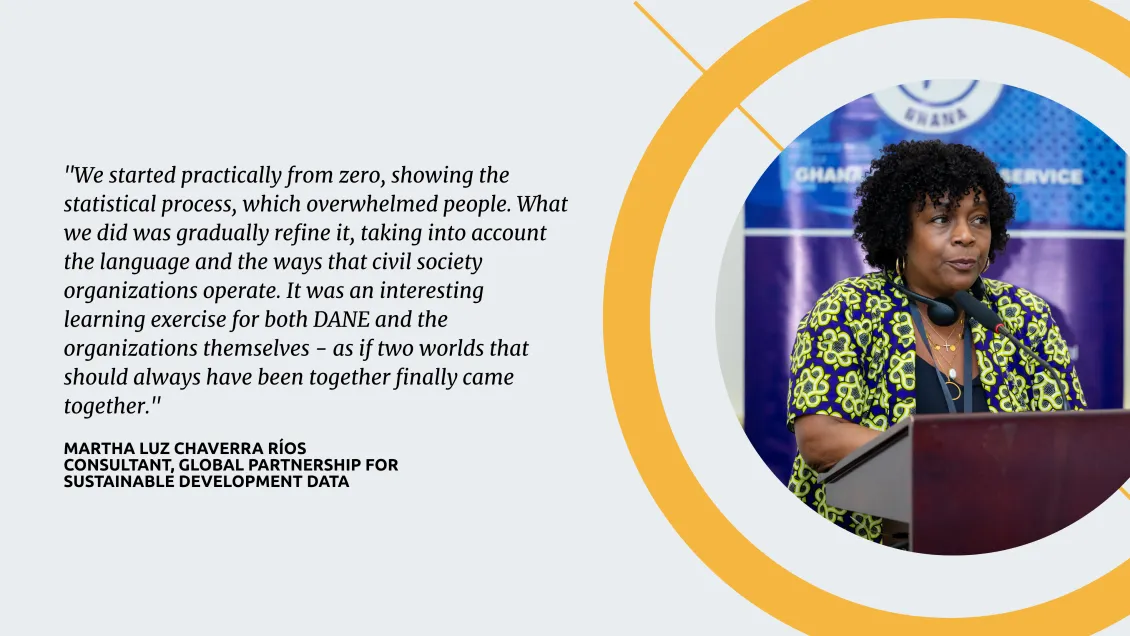
"In many of the projects we carried out in rural areas, when we did social cartography and identified the midwife's location, the conditions of social control were different from other areas. They exercise a quite interesting authority because the young people grow up - and who do they listen to? The midwife. You had to talk to the midwife to carry out any activity with young people, because they don't just know them - the young people actually listen to her."
Martha Luz Chaverra Ríos - Consultant, Global Partnership for Sustainable Development Data
The Colombia Maturity Model
Colombia’s citizen data framework incorporates a Maturity Model consisting of four progressive levels and dimensions: planning, governance and participation, methodology, and use and impact. This model helps grassroots organizations and citizen groups assess their practices and create practical improvement strategies. DANE adopted this approach due to the asymmetrical nature of the citizen data ecosystem, where a binary quality standard tends to favor larger, resource-rich institutions.
The Maturity Model offers a nuanced view of data quality as a trajectory rather than a fixed point, supporting recognition of both nascent and robust data. The model emphasizes process over product, ensuring that the voices of marginalized communities are included in data assessments. This approach allows organizations to identify their specific situational contexts and promotes a participatory methodology.
Colombia Diversa exemplifies the model's effectiveness through its longstanding commitment to LGBTIQ+ rights, emphasizing that revealing violence and discrimination requires comprehensive data beyond mere statistics. Their Human Rights Observatory contributes to ongoing reports regarding violence, underscoring that increased reports may reflect improved incident detection rather than a rise in violence. The collaboration with DANE evolved through a gradual process of building trust and engaging in training dialogues, culminating in participation in the Citizen Data Maturity Model pilot. This partnership transformed their relationship into a sustained collaborative effort. Through structured self-assessment within the model, Colombia Diversa evaluated its ethical obligations and community involvement in data practices.
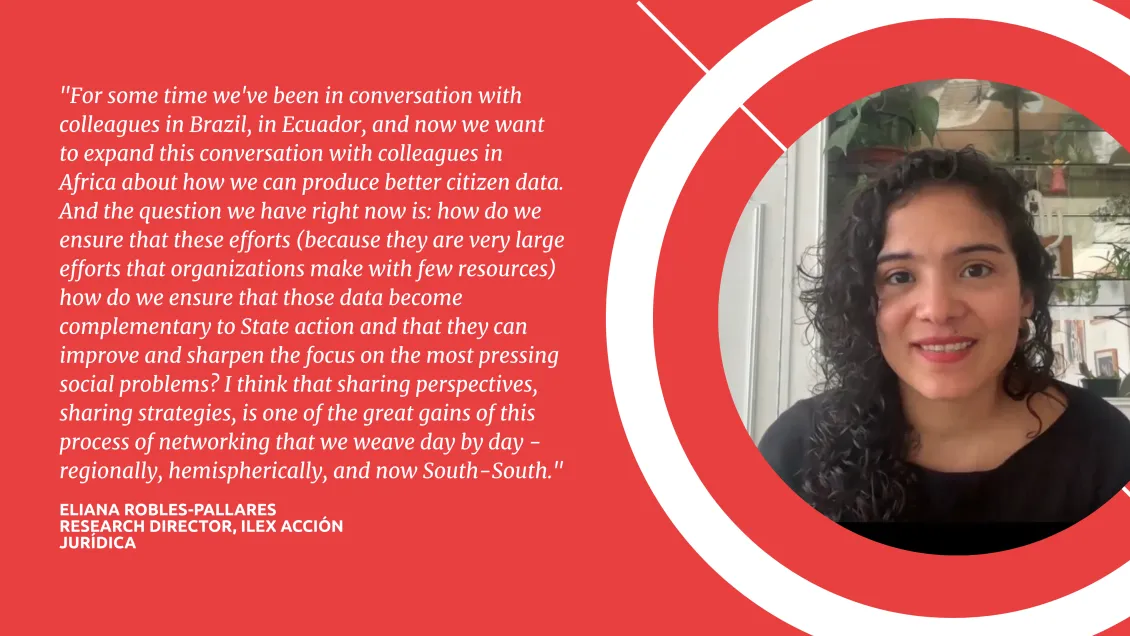
Key inquiries during the assessment addressed problem definitions, community representation in decision-making, and data protection protocols. The assessment underscored the necessity for distinct ethical guidelines for sensitive data management, prompting a reevaluation of their operational practices and the importance of sustainable data cycles and transparent documentation. By addressing these areas collectively, Colombia Diversa is aligning its observatory with national ethical standards while focusing on data justice and community-driven priorities. This outward-looking orientation is what makes initiatives like MIDN matter to civil society partners as much as to DANE. As Eliana Robles-Pallares, ILEX Acción Jurídica’s Research Director, puts it:
Colombia’s citizen data framework itself was built through this same collaborative logic: its development drew on contributions from 23 civil society organizations, 3 international cooperation organizations, and 9 entities from the national statistical system, who together established the dimensions, levels, and criteria through participatory workshops, thus ensuring the architecture governing citizen data was shaped by the same actors it is designed to serve.

Co-Creation in Practice: Opportunities and Challenges
Having gradual maturity levels enhances participation by accommodating small or grassroots organizations that contribute valuable information despite lacking formalized structures. This model recognizes the diverse pathways through which citizen data initiatives evolve and produce data. However, challenges may emerge if all dimensions are weighted equally, potentially placing disproportionate emphasis on administrative or methodological requirements while overlooking community participation, social data appropriation, and ethical considerations. For effective integration of data from organizations, it is important for the State to clarify how such data will be considered complementary. Greater clarity in this regard can help ensure that organizations engage under transparent expectations and with roles that are appropriately aligned with public responsibilities.
Gradual maturity levels also influence participation by acknowledging the time, continuity, technical capabilities, and financial resources necessary for producing citizen data. Progression relies on adequate human resources and protected time rather than mere willpower. In this context, DANE’s role can extend beyond methodological guidance to include capacity strengthening and knowledge transfer as part of a shared responsibility framework. Trust between national statistical offices and civil society strengthens when co-creation, feedback, and shared decision-making processes are meaningfully implemented and supported in practice.