The Citizen Data Framework is expected to be published with practical tools for implementation, while the Maturity Model and its self-assessment instrument will remain key resources for organizations to identify their current level and design gradual capacity-building pathways. Looking forward, the next steps include community-led workshops and an advanced virtual course on citizen data that builds on an existing introductory course. The broader strategy is to move from training focused primarily on data collection toward training that strengthens autonomy, enabling communities and organizations to develop and sustain their own data systems.
Other National Statistics Offices can replicate DANE’s citizen data approach using the following three-part strategy
- Tie training to a structured roadmap rather than isolated skills, as our capacity building aligns with the Maturity Model, making high-level statistical, ethical, and governance standards accessible to grassroots organizations. This model serves as a diagnostic tool for organizations to assess their current standing and identify necessary skills for advancing data maturity, transforming abstract learning into a tangible institutional pathway.
- Democratize statistical culture through the development of an advanced virtual course and the publication of the Citizen Data Framework as an open resource, making high-level statistical standards accessible to grassroots organizations; making ethical standards and governance public property.
- Community leadership of peer-to-peer learning: training conducted by community leaders, such as midwives sharing knowledge about data, often proves more enduring than traditional top-down instruction. Consequently, organizations may find that their most effective trainers are community partners rather than formal statisticians.
“Long-term sustainability looks like a statistical ecosystem where citizen data is a regular part of how evidence is produced, rather than a one-off project. Technically: It means the Maturity Model remains a permanent, living resource that organizations use for continuous self-assessment and improvement. Socially: It means achieving 'genuine co-creation' where trust replaces skepticism. Politically: It means realizing that this is not just a technical upgrade, but a 'political and social commitment to democratizing data', where communities are permanently recognized as legitimate producers with their own expertise. Ultimately, Data in Action is not only a technical initiative but a political and social commitment to democratizing data, aligned with global efforts to make data systems more inclusive.”
DANE
To move from experiment to norm
It is essential to anchor citizen data in the legal and strategic backbone of the state. In Colombia, DANE is doing this through three specific systemic changes:
- Legal Mandate: The implementation of Law 2335 of 2023 facilitates the integration of non-traditional sources into DANE's standards, transforming citizen data into a legally recognized element of the National Statistical System.
- Strategic Commitment: This initiative is entrenched in the National Statistical Plan (PEN) under Goal 35, prompting systemic change through the establishment of solid guidelines and partnerships for citizen involvement, thereby ensuring longevity beyond individual administrations.
- Standardization of Quality: Workshop discussions highlight the necessity for 'institutional reengineering' to replace ad-hoc validation practices. The introduction of the Citizen Data Framework and Maturity Model establishes a governance structure that supports data validation through ethical and methodological clarity rather than subjective assessments.
By emphasizing that citizens not only respond to surveys but also produce and utilize data, Colombia aims to establish a statistical ecosystem where citizen-generated data is integral to evidence creation and application, moving beyond isolated experiments. To civil society organizations (CSOs) globally, it is recommended that successful alliances be founded on trust, mutual respect, technical expertise, and complementary roles. National statistical offices supply methodological frameworks, while social organizations provide research-based evidence and insight into social realities that often escape official statistics. The collaboration must be continuous and dialogical to meaningfully inform implemented instruments. The full potential of citizen data is unlocked through sustained relationships aimed at institutional transformation rather than mere consultation. Furthermore, this process exemplifies how cross-sector collaboration can enhance information production and usage, leading to methodologies for better comparability of CSO data both nationally and internationally.
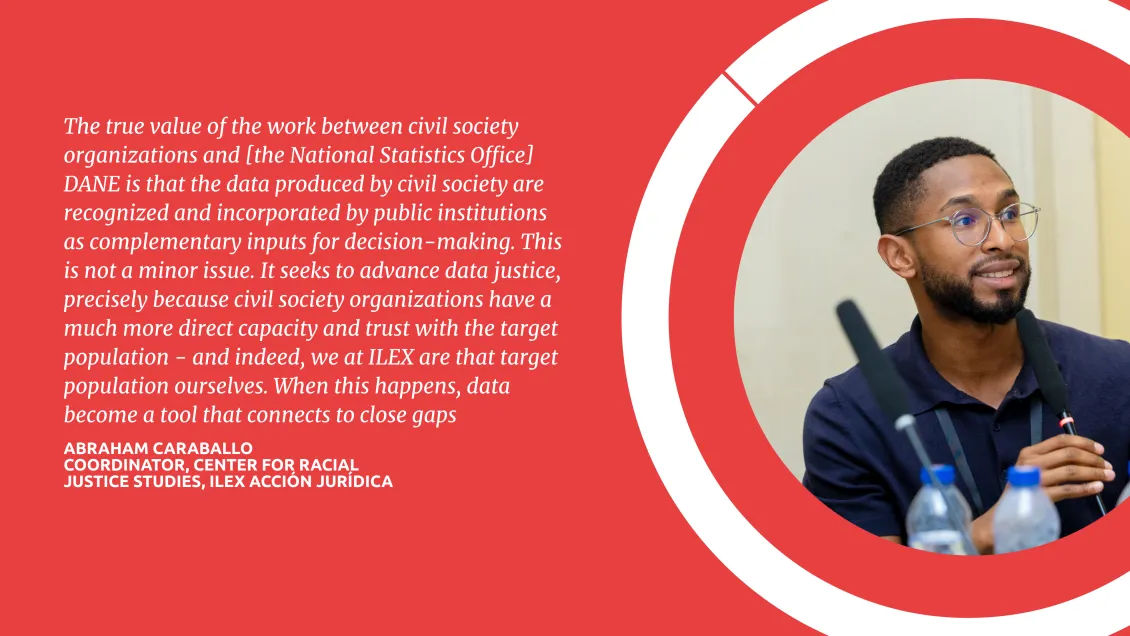
Ultimately, the experience demonstrates that technical capacity strengthening is not an end in itself, but a pathway toward more inclusive evidence ecosystems, stronger public decision-making, and greater data justice; a pathway Colombia is walking alongside Ghana and Kenya through the Make Inclusive Data the Norm initiative.